
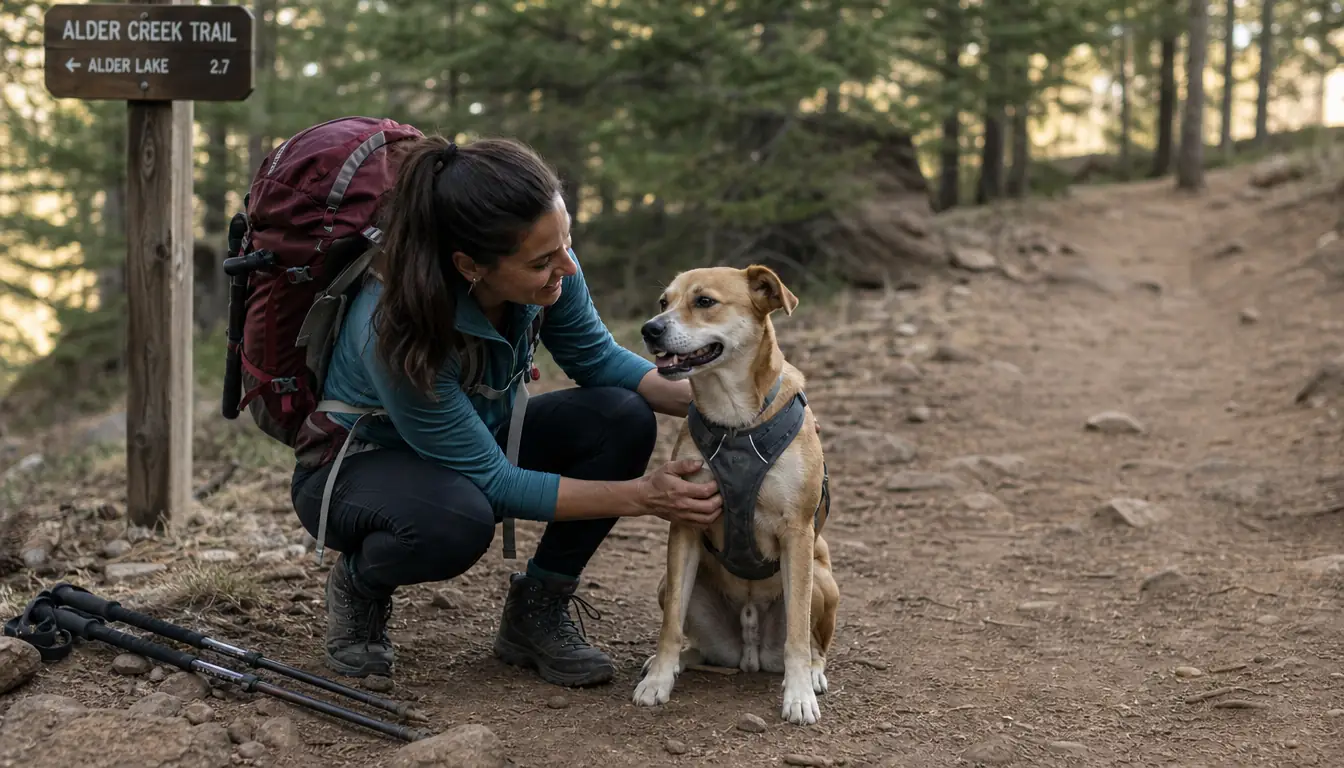
A harness that fits badly does not announce itself in the kitchen. The dog stands there looking fine, the straps look even, and you head out. Two miles up a trail it has slid around to one side, or it has rubbed a patch behind the front legs, or your dog has started walking with his head low and his shoulders hunched to get away from the thing. I spent Moss's first two weeks with us clipping a leash to his flat collar and wondering whether a harness was even worth the fuss. It was.
About two weeks after Moss came home from the rescue, four years ago now, I bought a Ruffwear Front Range chest harness in Medium. He is a 46 pound Australian shepherd mix, about 21 inches at the shoulder, 28 inches around the chest. Fitting it took me roughly 10 minutes on the kitchen floor, with the dog sighing at me the whole time. I have not moved a strap since. Here is the whole process in the order I would do it again, including the two measurements that matter more than everything else combined, and the twenty minutes of fumbling I did first so you can skip it.
One fitting, four years of trails, no straps touched since
The Ruffwear Front Range chest harness in Medium is what Moss has worn on every short hike and every snowshoe day since his first month with us. Two leash points, foam padding across the chest, hand wash only. If your dog measures close to him, this is the size to start with.
Amazon Check Today's Price on Amazon →Step 1: Measure the Chest Girth, Not the Neck
You need one number before anything else, and it is the chest girth. Not the neck. Almost everyone measures the neck first, because that is where a collar sits and it is the number they already have in their head from the last time they bought something. A harness carries load across the chest and shoulders, so the chest is the number the size chart is actually built around. A neck measurement tells you almost nothing useful here.
Put the tape around the widest part of the ribcage, just behind the front legs where the ribs are deepest. Keep the tape level the whole way around rather than angling it up toward the shoulders. Snug enough to sit against the fur, no tighter. My own first attempt was with a stiff metal tape from the garage, and it read 26 inches because the tape bridged the hollow behind his shoulder instead of following it. I remeasured with a cloth tailor's tape, twice, and got 28 inches both times. That two inch gap is the difference between a harness that sits flat and one that rides up and pulls.
A cloth tailor's tape is the right tool. String and a ruler works in a pinch, but only if you mark the string and lay it flat to measure it afterward. Then take that number to the size chart on the specific listing and match it there. Sizing is not consistent between brands, so a Medium in one is not a Medium in another, and a number is worth more than a guess. Ruffwear publishes a girth range for each size on the Front Range listing. Read the range, do not read the word Medium and assume.
Step 2: Weigh the Dog and Note His Shoulder Height
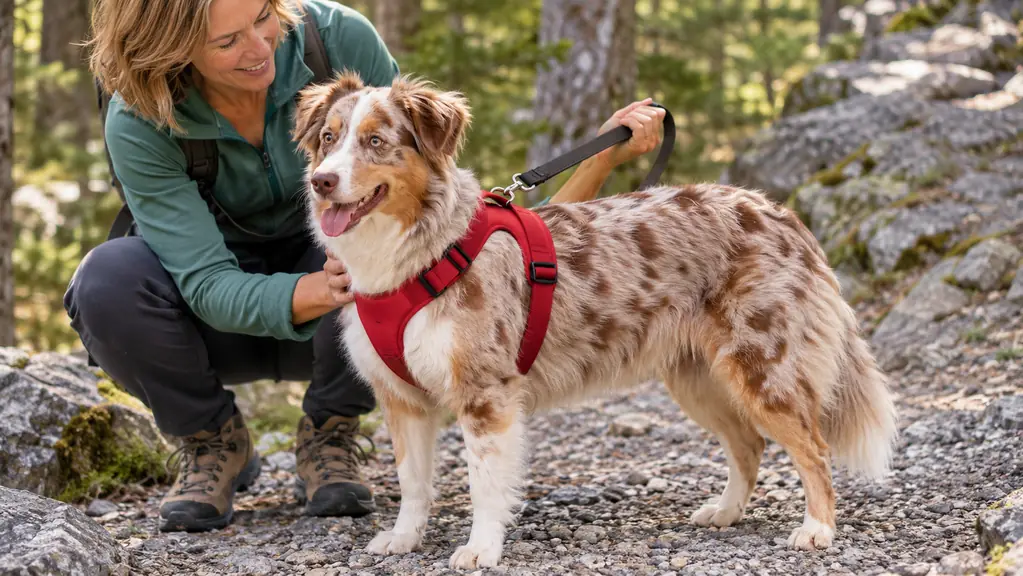
The second number is weight, and the third is shoulder height, measured from the floor to the top of the shoulder blades. Neither one picks the size on its own. What they tell you is whether your dog is in the middle of the range the harness was designed around or sitting out at the edge of it, which is where fit gets fussy.
Moss is 46 pounds and about 21 inches at the shoulder. He is not a deep-chested dog and he is not a barrel either, so his chest number and his weight agree with each other. If your dog is built low and wide, thick through the ribcage on short legs, trust the girth measurement over the weight every time. A dog can sit well inside the weight range and still be too broad for the chest panel to lie flat. If you are between sizes and want a real number rather than a bathroom scale and a squirming dog, weigh him on the platform scale at the vet's office on your next visit and write it down.
Here is the practical part. If your chest girth lands right on the line between two sizes, order both and send one back. I know that means paying twice and waiting on a refund. It is still faster than a harness that half fits, and fitting is the one place I would not try to split the difference. Too big and the harness slides and rubs. Too small and you cannot set the chest strap where it needs to sit.
Step 3: Loosen Every Strap Before the First Fit
Every adjustable strap on a new harness arrives close to its tightest setting. That is fine for shipping and wrong for fitting. Before you take it anywhere near your dog, back every strap out most of the way. You want the harness at its loosest so it drops over the head without a wrestling match on the first attempt.
The Ruffwear Front Range is a pull-on harness. No buckle to fight with. You loosen the neck straps, slip the whole thing over the dog's head, and then guide one front leg through the leg opening. That is it. Do it on the floor rather than standing over him, and have a few treats in your pocket the first time. Standing over a dog with a piece of gear in both hands is the fastest way to convince him something unpleasant is coming.
If your dog backs away, stop and reset rather than chase him around the kitchen with the thing. Put it on, take it off, treat, repeat. Moss was fine with it on the first evening, mostly because he was still new enough to the house that he followed me anywhere I went. He did sigh dramatically every time I moved a strap, which I chose to take as commentary. Some dogs need a week of that routine before they stand still for it. Both kinds of dog end up in the same harness, so there is nothing to prove on day one.
Step 4: Adjust Neck First, Then Chest, Then Check the Two Finger Rule
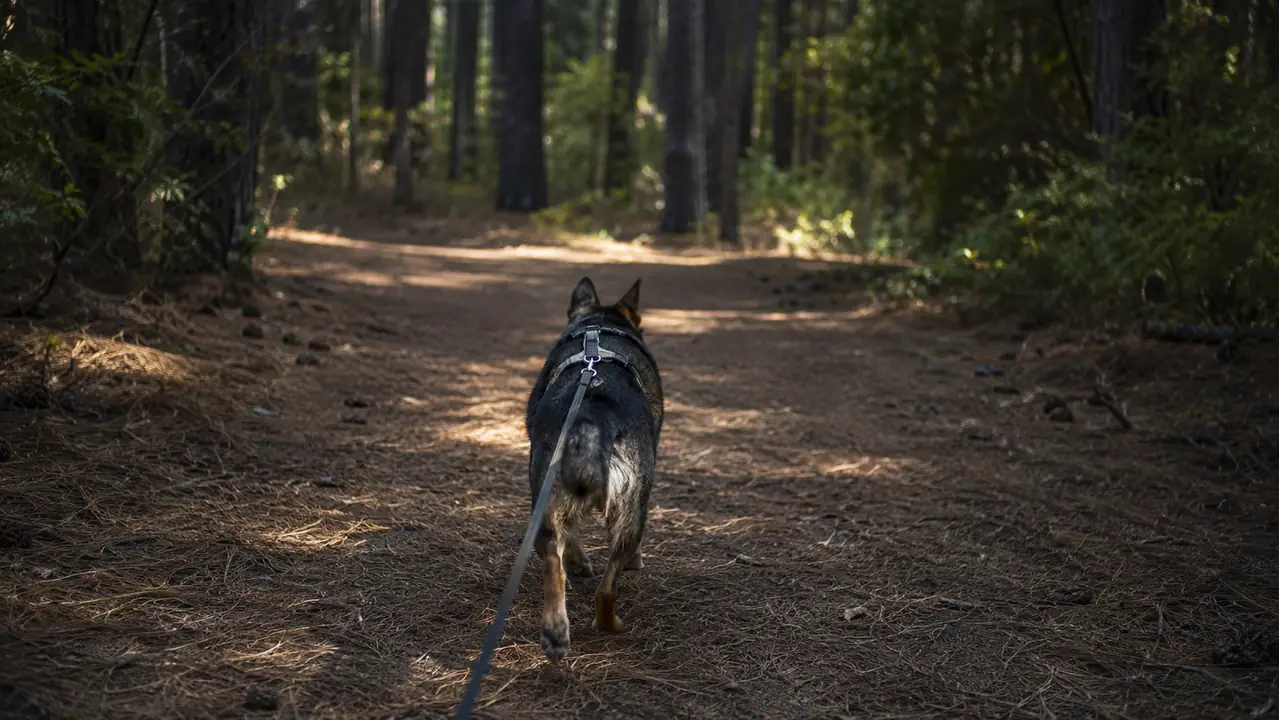
Start at the neck. The neck straps should let you slide two fingers flat under the strap at the base of the neck and no more than that. Tighter and the harness pulls at the throat every time your dog lowers his head to sniff, which on a trail is roughly every forty feet.
Then the chest straps. These set where the padded front panel sits on the ribcage, and you want it behind the front legs, not tucked up in the armpit where it will rub on a long descent. Two fingers under those as well. Check each side separately, because it is very easy to tighten one and leave the other loose and then wonder why the panel sits crooked. I did exactly that on the first evening and spent another five minutes evening the two sides back out.
Last, look at the two leash points. This harness has a V-ring on the back and a loop on the chest. On a normal day I clip to the V-ring on the back and never think about it again. The chest loop gets used on the odd day Moss decides he wants to go and meet a deer, and it turns him back toward me without any hard jerking on his throat. Once it is on, walk the dog around the yard for a minute and watch the front panel. If it swings to one side, one chest strap is shorter than the other, and evening them up is the fix, not a different leash.
Step 5: Test It on a Short Flat Walk Before a Long One
Do ten or fifteen minutes on the sidewalk or a bike path, nothing that needs route finding. You are checking three things: whether the harness stays centered when your dog turns, whether anything is rubbing, and whether your dog walks normally in it. A dog that suddenly shortens his stride is telling you something.
Rubbing turns up behind the front legs, up in the armpit, and along the top of the shoulder. When you get home, run your hands under every strap. Warm is normal. Damp, or a red patch, is not, and it means the strap is too tight or the front panel is sitting too far forward. Give it two or three short walks before you decide the fit is wrong, because fur and padding both settle after a few wears and a strap that felt snug in the kitchen can feel different by the third outing.
Sliding shows up when your dog turns to look at something. If the harness rolls to one side and stays there, go back and even up the chest straps before you go any longer. On our first real hike, six or seven miles on a Cascade trail outside Bend, it stayed centered all day and I did not touch it once. That has held for four years now, snowshoe days included. The only time it shifts at all is when Moss rolls in something at the trailhead, and that is a washing problem, not a fitting problem.
Ten minutes on the kitchen floor the first evening. Four years of trails since, and the straps have not moved.
What Else Helps
Keep the flat collar on. Moss wears his with his ID tags on every single hike. What changed is that the leash does not clip to it out on a trail anymore, because a collar pulls at the throat while a harness spreads that pull across the chest and shoulders. That was the whole reason I switched, and it is the reason I would switch again.
The reflective trim is worth knowing about even if you never hike in the dark. It shows up in headlights in a parking lot at dusk, which is the situation I actually run into. There is also a dedicated loop for a beacon light, sold separately, and that loop gets the most use from me in the fall when the light goes early and we are coming down the last mile.
Care is simple and slightly annoying: hand wash only. On dry trails it picks up burrs and dust, and I knock the burrs off with my fingers at the trailhead before they work into the padding. I rinse it in the sink two or three times a season with a little mild soap and hang it over the back of a chair to dry. It lives on a hook by the back door with the leash. Nothing on it has broken in four years. The color has faded, which is what happens to anything that spends its life outside.
One more thing about which piece of gear does which job. On hikes over about five miles and on our one or two overnights each summer, Moss wears his Ruffwear day pack instead of the harness, and the leash clips to the pack's own leash point. Short hikes and every snowshoe outing are harness days. If your dog is only ever doing a few miles at a time, the harness is the piece you need and the pack can wait until you are both ready for longer days.
Measure once on the kitchen floor, then stop thinking about it
Chest girth, weight, shoulder height, then the size chart on the listing. If your dog measures anywhere near 28 inches around the chest and 46 pounds, the Medium is where I would start. Hand wash only, two leash points, and a fit that has not needed a single adjustment in four years.
Amazon Check Today's Price on Amazon →