
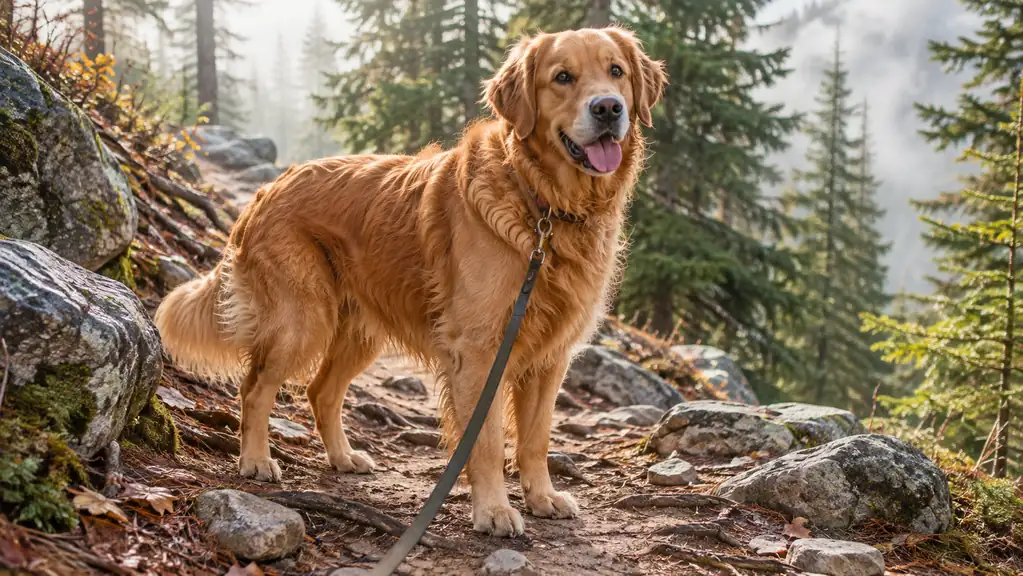
The first two weeks Moss lived with me, the leash clipped to the flat collar he came home from the rescue wearing, because that was what we had. Then we walked a trail south of Bend with a lot of roots and a lot of ground squirrels, and I spent four miles watching the leash go tight at the front of his neck while he leaned into it. Two weeks later I bought a Ruffwear Front Range Harness. That was four years ago. Since then the leash has not clipped to that collar on a trail once.
So here is the short answer, before the long one. On a hike, the harness wins and it is not close. Around town, in the car, in the yard, anywhere Moss is just wearing his tags and being a dog, the flat collar wins and I would not change a thing. They do two different jobs. The trouble starts when you ask one of them to do both.
| Ruffwear Front Range Harness | Flat collar | |
|---|---|---|
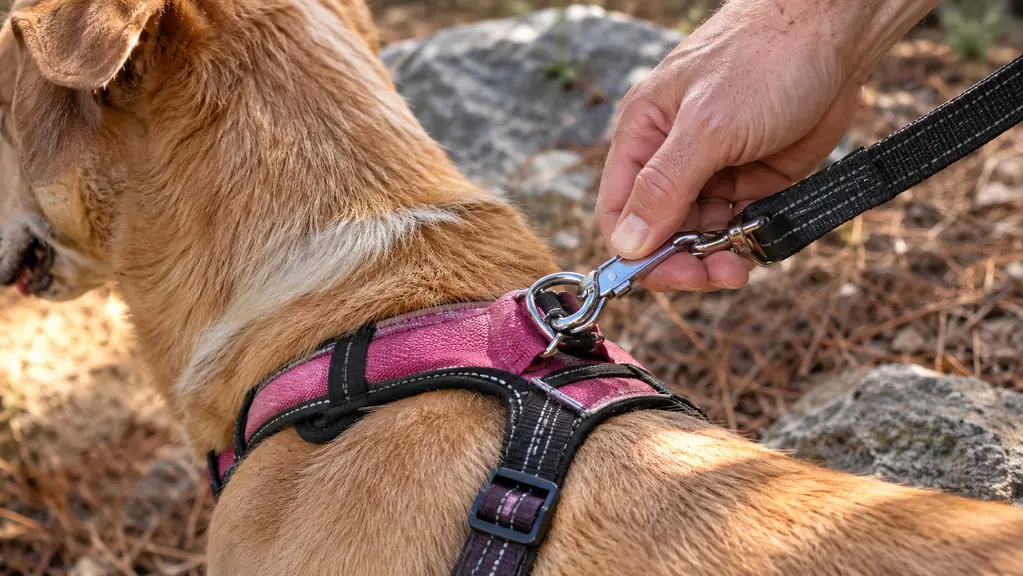
| Where the leash clips | Two points: a V-ring on the back and a webbing loop on the chest | A single ring on the collar band |
| Steering on a pull | The lower chest point turns the dog sideways instead of letting him drive forward | All the tension lands at the front of the throat |
| Padding | Foam-padded panels across the chest and back | A nylon band with no padding |
| Adjustability | Adjustable for all dog types, and mine has not needed a change in four years | Sized band with no real adjustment |
| Putting it on | Pull it on over the head, then settle it straight | One hand, one second, no fitting |
| Everyday wear and ID tags | A piece of gear that goes on and comes off | Stays on all day and holds the tags |
| Care | Hand wash only, and the webbing collects burrs and dust | Wipes clean in about ten seconds |
| Visibility in low light | Reflective trim plus a dedicated loop for a Beacon Light | Tags catch a little light, nothing reflective built in |
| Best for | Trail days, snowshoe outings, any hike where I need both hands | The car, the yard, the sidewalk, the parking lot |
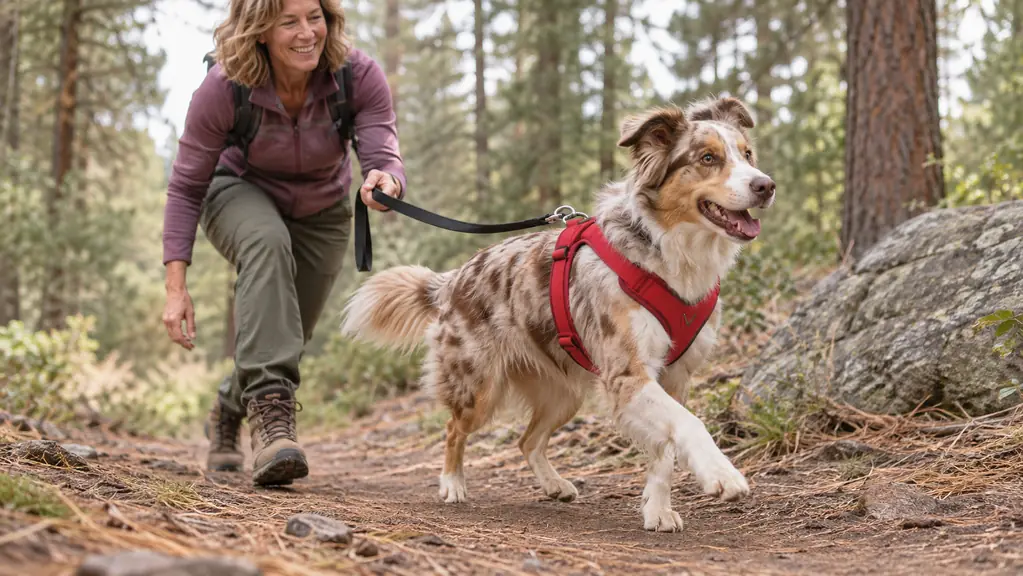
Some context on the miles, so you can weigh this against your own dog. Moss is a 46 pound Australian shepherd mix, six years old, about 21 inches at the shoulder and 28 inches around the chest, and he wears a Medium. We do day hikes of 4 to 9 miles most Saturdays from spring through fall, snowshoe outings in winter, and one or two short overnights each summer. Nothing technical, no peaks, no races. Everything below comes from those walks and not from a testing lab.
Where the Front Range Harness Wins
The second leash point is the part I did not expect to use. For most of the first year I clipped to the V-ring on the back and forgot the chest loop existed. Then Moss started going after ground squirrels, and one morning I tried the chest loop on a whim. A leash clipped low on the chest turns him sideways instead of letting him drive forward into the tension. I am not a trainer and this is not a training method. It is just where the pressure lands, and on the odd day he decides the wildlife is worth a discussion, it is the difference between a walk and a wrestling match. I go back to the back point the moment he settles down.
The padding earns its place on longer days. There is foam padding through the chest and back panels, and on a 9 mile day with a lot of up and down I do not think about the harness at all, which is the highest compliment I can pay a piece of gear. Fitting took about ten minutes, and most of that was me being careful. I loosened every strap before I put it near him, which sounds backwards but is the only way to get a pull-on harness over a dog's head without a fight. Then it went over his ears, I settled the chest panel, and I slid two fingers under each strap to check the gap. We walked the hallway four or five times while I watched the back panel for movement, and I took up a little slack on the shoulders and left it alone.
Moss is not a dog who stands still for much, and he stood still for that because I had a handful of kibble. On the trailhead it would have been hopeless. Four years later I have not touched a strap since, and I have not found a rub spot.
This is the Ruffwear harness that has been on every hike under about five miles and every snowshoe outing for four years, and nothing on it has broken. The reflective trim on the webbing is there on the walk back to the car when the light is going. There is a dedicated loop for a Beacon Light, which I have never actually bought, but the loop is there. The whole thing weighs 5.92 ounces, which on a 46 pound dog he does not appear to notice.
One more thing that matters more than it sounds. With a waist leash buckled around me and a pair of trekking poles in my hands, the snap meets the back leash point at an angle that keeps the line off my legs. On a narrow trail with brush on both sides, that is the difference between a smooth walk and a leash that snags every twenty feet.
Where the Flat Collar Wins
The collar wins the morning-of argument every single time. Moss wears his flat collar with his ID tags all day, every day, at home and in the car and on the sidewalk, and the harness lives on a hook by the back door and only goes on when we are actually heading out. If your dog's big outing is a loop around the block, a collar is genuinely all you need, and a harness is a fix for a problem you do not have.
It also wins on care, and this is the one that irritates me. The harness is hand wash only. It picks up burrs and dust on every fall hike, and I have spent more evenings than I would like picking seed heads out of the webbing with my fingers while Moss watched me from the rug. The collar wipes clean in about ten seconds. Four years in, the harness fabric has faded in a way the collar has not, which is cosmetic, but it is real.
And the collar is the thing that gets your dog home if he ever slips a leash, because that is where the tags live. That has never happened with Moss, and I still would not walk him without it. The harness is gear. The collar is identification. I would not trade one for the other and I would not leave the driveway without both.
There is a small thing I did not expect either. Moss is easier to handle in tight quarters on a collar. Loading him into the back seat of the Outback, threading a crowded trailhead, stepping over a fallen log, all of that is a hand on the collar and a word, and the harness does not help with any of it. The gear that helps on a narrow ridge is not always the gear that helps in a parking lot. A harness gives you control at the end of a leash. It does not help you lift forty six pounds of dog over a log, and there is a stretch of trail off the Cascade Lakes Highway with three logs in a quarter mile where I do exactly that every spring.
Four years, a lot of Saturdays, no rub spots I can find, and the leash still has not clipped to that collar on a trail.
The collar is for the driveway. This one is for the trail.
Two leash points, foam padding through the chest and back, and a fit that took ten minutes in the kitchen and has not moved since. Moss wears a Medium at 46 pounds and a 28 inch chest.
Amazon Check Today's Price on Amazon →What About Pack Days
On longer days the harness comes off entirely. Once we are past about five miles, or on an overnight, Moss wears his Ruffwear day pack instead and the leash clips to the pack's own leash point. That is not a knock on the harness. It just means that if you are already carrying a pack for your dog, the pack takes over the job and you do not need both pieces on the same walk. Two things competing for the same real estate on a dog's back is worse than one.
The pack has three leash attachment points of its own and I use the one on the back, same as the harness. Balancing it takes a minute: one 20 ounce bottle in each side pocket, poop bags and a few treats in the middle, then a squeeze of each side to check it sits level before we set off. The first two short outings Moss walked a little stiffly with it on. By the third he ignored it entirely, which is the whole adjustment as far as I can tell. On a hot day the pack stays home even on a long hike, because it sits warm across his back, and the harness goes on instead even though the miles would justify the pack.
For snowshoe days the pack stays home and the harness goes on, because the load is not the point on snow, the leash is. That split has held for two years now and it has kept both pieces in good shape. If I had to pick one for a dog who only ever does day hikes, it is the harness. The pack is the luxury. The harness is the baseline.
Who Should Buy Which
Buy the harness if you hike with a leash, and especially if you use trekking poles. A waist leash clipped to a back leash point keeps both hands free, and a padded chest panel keeps tension off the front of your dog's neck on the pulls. Buy it if your dog is on the larger side of medium and you want padding rather than a webbing strap across the chest. Buy it if you want a second, lower leash point for the days your dog decides the wildlife is more interesting than you are, even if you only reach for it a few times a season.
Keep the flat collar as the everyday setup no matter what. It holds the tags, it goes on in about a second, and it is the thing that identifies your dog if the worst happens. I would not switch to a harness for town walks and I do not think most people should. The two together take up one hook by the back door and about ten extra seconds before a hike, and that is the whole trade.
What I'd Watch For Before You Buy
Fit first. The harness is pull on, so you are drawing it over your dog's head and settling it, and the first fitting is worth doing at home where your dog is calm rather than in a trailhead parking lot with the clock running. A harness that is too loose shifts on a downhill, and you feel it through the leash before you see it. One that is too tight will rub. Neither shows up until mile four, which is a bad place to find out. My own check is a fingertip under the chest panel and under each shoulder strap, then a look at the skin behind his front legs at the halfway point of the first few hikes. That is where a rub would start, and a thick coat hides it well.
Second, do not expect a harness to fix pulling. It does not, not on its own. Moss still pulls toward wildlife on the odd day, and the chest loop only redirects him. That is all I would claim for it, and I have four years of walking behind that opinion. If pulling is your main problem, this is not the piece of gear that solves it.
Third, the burrs. If you hike in the fall where there is cheatgrass or burdock, the webbing collects it. Brush the harness off at the car before it goes on the hook. That takes a minute. Leaving it until the next Saturday takes twenty, and I have done both enough times to know the difference.
Last, think about what you are actually buying it for. A harness does not turn a dog into a trail dog and it does not add miles. Moss hiked the same trails at the same pace the year before I bought it and the year after. What changed was me. I stopped thinking about his neck on a pull and started looking at the trail instead.
Four years, one hook by the back door, nothing broken
Moss wears the Ruffwear harness on every hike under about five miles and on every snowshoe day. The flat collar rides along for the tags. The harness does the trail.
Amazon Check Today's Price on Amazon →