
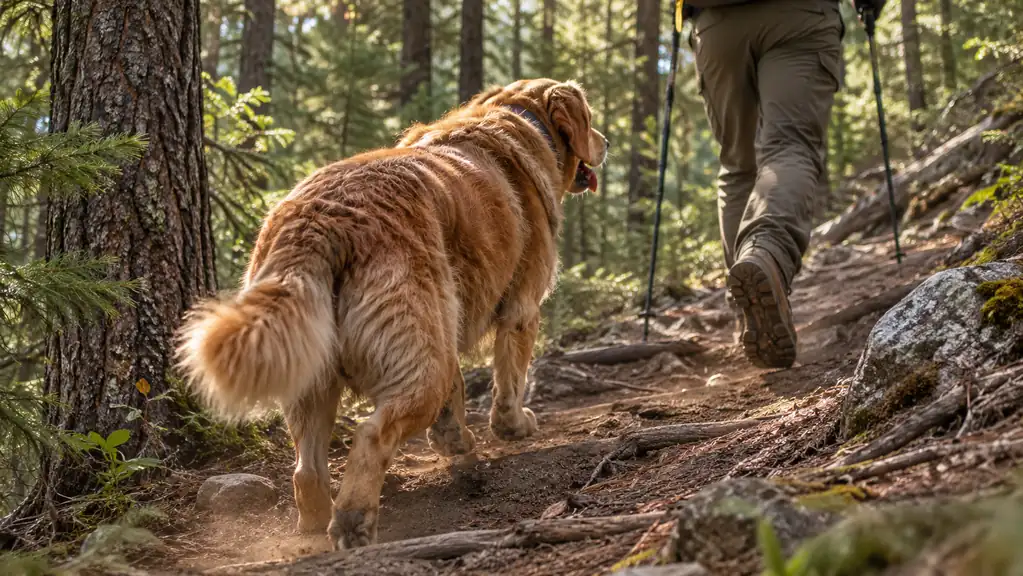
Every Saturday from spring through fall, Moss and I are on a Cascade trail somewhere west of Bend. He is a 46 pound Australian shepherd mix, six years old, and he has been hiking with me for about four years now. For the first two weeks after he came home from the rescue, I walked him on his flat collar, the way I had walked every dog before him. Then we went up a trail with a long switchback and a chipmunk at the top of it, and I spent the rest of that climb thinking about his throat instead of the trees.
Two weeks in, I bought the Ruffwear Front Range chest harness, medium, and it has been the piece of gear I reach for on every hike under about five miles and every snowshoe day since. On longer days and overnights Moss wears his Ruffwear day pack instead, and the leash clips to the pack's own leash point. The collar still rides on him with his ID tags, because that is what a collar is for. The leash just stopped clipping to it on a trail. Here is what actually changed, in plain terms, and where a collar is still the right answer.
The harness I have put on every Saturday for four years
Pull on closure, foam padded chest panel, two leash points, 5.92 ounces. That is the whole pitch and it has been enough for four seasons of trail days.
Amazon Check Today's Price on Amazon →The pull lands on his chest, not across his windpipe
On a sidewalk a flat collar is fine. On a climb, every time Moss leaned into the leash to get a better sniff uphill, that lean ran across the front of his neck. The Ruffwear harness moves it. The foam padded panel spreads the same pull over a wide, muscled part of him, and the leash point sits above his shoulders instead of under his chin. I noticed it most on descents, which is where he used to lean hardest and where I used to shorten my own stride to keep slack in the line.
Two leash points, so I can match the clip to the moment
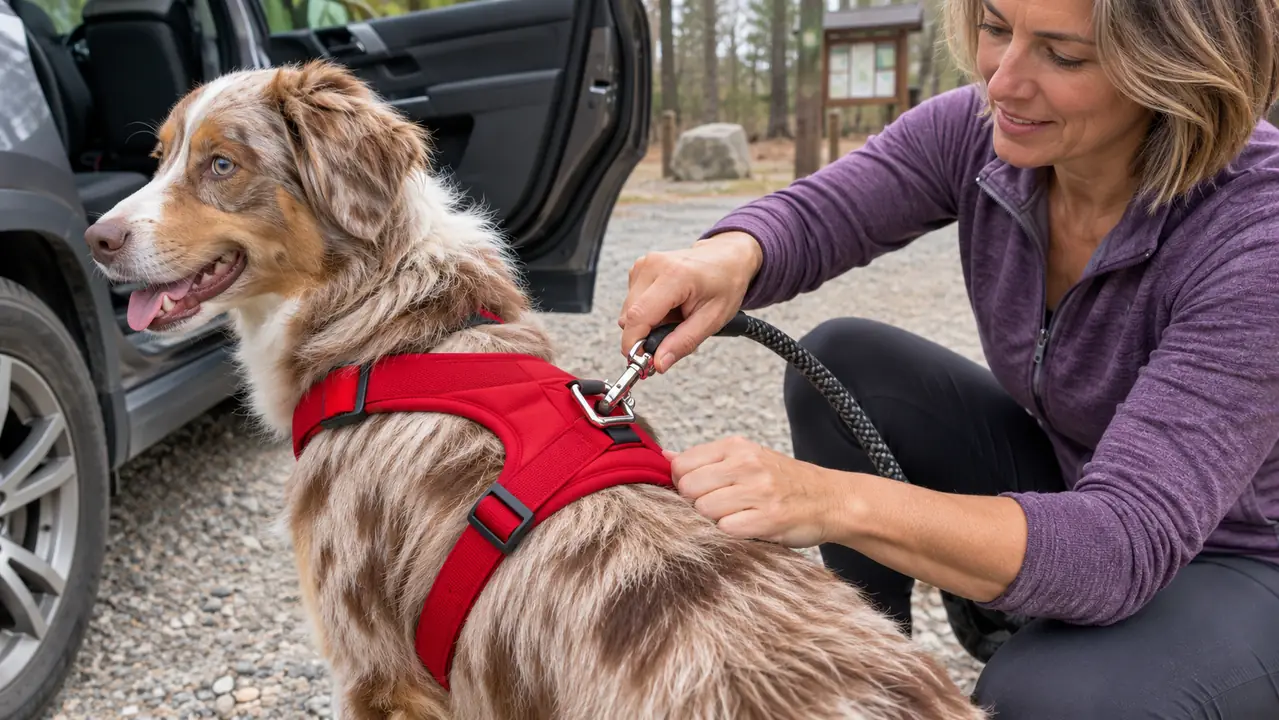
There is a leash point on the back and a second loop on the chest. Ninety-five percent of the time I clip to the back, because that is where a dog walking ahead of me on a bungee wants the connection. The chest loop comes out on the odd day Moss decides a mule deer is the most interesting thing he has ever seen. Clipping there turns him gently back toward me instead of letting him tow. I have used that loop maybe a dozen times in four years, and I am glad it is there every single one of them.
It goes on in one motion at the trailhead
The closure is a pull on design. No buckle to line up in a parking lot with cold hands and a dog who can already hear the trail. I open the neck, drop it over his head, settle the chest panel, and we go. Four seconds, roughly, which matters when the Outback is idling, Moss is doing his excited shuffle, and I am still trying to get my trekking poles out of the back.
I adjusted it once, the first evening, and never again
Fitting took about ten minutes on the night I brought it home, working the straps a little at a time and watching how it sat while he walked around the yard. I have not touched the adjustment since. Some of that is the straps holding where you put them and some of it is that Moss has not changed shape much. It sits centered, the panel stays flat, and nothing has rubbed a bare patch. If your dog is still filling out, expect to revisit the straps a couple of times.
The padding still has shape after four seasons
Thin padding compresses and quietly stops doing its job. This is a foam padded construction and it has held up through four years of Saturdays, one hand wash a season, and a lot of brush. On a nine mile day, which is the long end of what we do, I check him over at the turnaround. No chafe behind the front legs, no rubbed fur, no hot spot. Not because the foam is special, but because a wide padded panel does not concentrate force the way a thin strap does.
There is a dedicated loop for a clip-on light
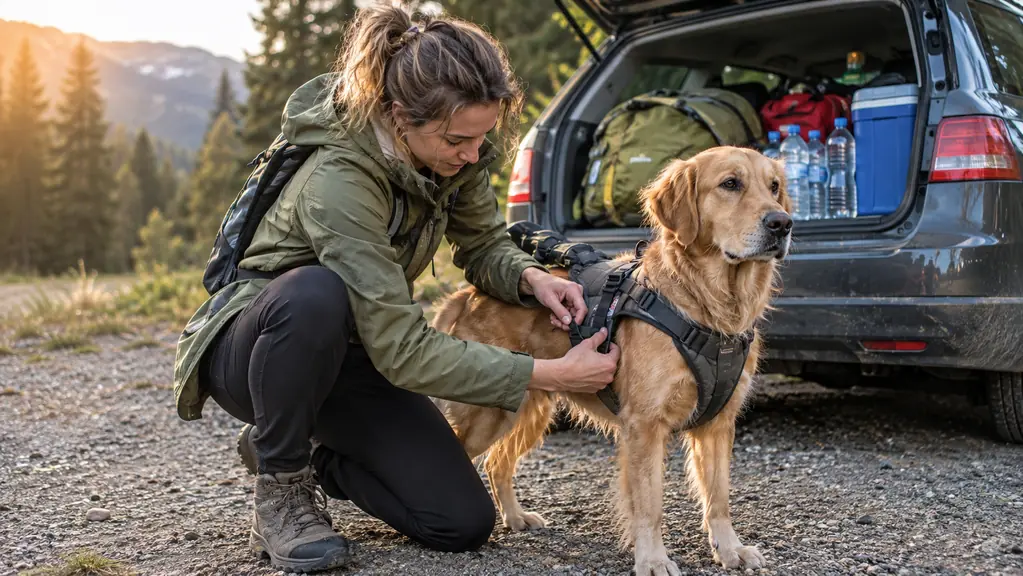
Specs are one thing and a dark trailhead is another. The harness has a small loop made for a Beacon Light, which is sold separately, and it sits right where you would want a light to ride. I use a cheap clip-on from the hardware store instead. The light does not come with the harness, so plan for that. But having the loop means the light rides up on his shoulders instead of swinging off a collar and flashing in his eyes on the downhill.
Reflective trim earns its keep in the last twenty minutes
The harness has reflective trim stitched into it, and it does its best work in the flat grey light under the trees at the end of a fall day. I am not going to tell you it makes a dog visible from half a mile. It catches a headlamp and it catches low beams, and on the shoulder of a Forest Service road on the walk back to the car, that is the whole point.
At 5.92 ounces it always comes along
Five point nine two ounces is less than the water I carry for Moss. It lives on a hook by the back door with the Tuff Mutt leash, and when it is wet or dusty it goes in the truck anyway because it weighs so little that there is no reason to leave it behind. For a piece of gear I grab without thinking, low weight is what stops me from talking myself out of bringing it on a short afternoon hike.
It stays centered when he scrambles over logs
Moss climbs over downed logs and scrambles up short rocky steps, and a loose harness slides in exactly those moments. This one does not, because the adjustable straps hold where you set them and the chest panel stays flat against him through the awkward moves. It means I am not stopping mid climb to shove a strap back into place. That sounds like a small thing. Over four or five hours it adds up to a lot less fiddling.
Four years in, nothing has broken
Something like five hundred miles, one wash a season, burrs every week in late summer. No stitching has let go. No strap has frayed at the edge. No ring has bent. The fabric has faded and it holds trail dust better than I would like, but that is cosmetic and it is on me for not rinsing it. The Ruffwear Front Range harness is the one piece of gear I would replace the same day it failed, and it has not given me a reason to.
What I'd Skip
If you are hoping a harness will fix a hard puller, it will not. The chest loop gives gentle steering, not brakes, and I would not put a dog who lunges at other dogs on a bungee leash with it either. I would skip it if you only walk sidewalks in town, because a flat collar does that job with less fuss and less gear to rinse. And know the care instructions before you buy: hand wash only. It picks up burrs and dust, it is warm on a hot day, and a rinse in the sink is part of your season whether you enjoy it or not. I have never owned another harness, so I cannot tell you how the Ruffwear Front Range compares to a different brand. I can only tell you I never went looking for one.
Fitting took about ten minutes on the first evening. Four years and a few hundred trail miles later, I have not touched the straps since.
Four years of Saturdays, one harness, and I never went looking for another
Pull on closure, foam padded, two leash points, reflective trim, 5.92 ounces. Moss is 46 pounds and 21 inches at the shoulder and he wears a medium. Check today's price on Amazon.
Amazon Check Today's Price on Amazon →