
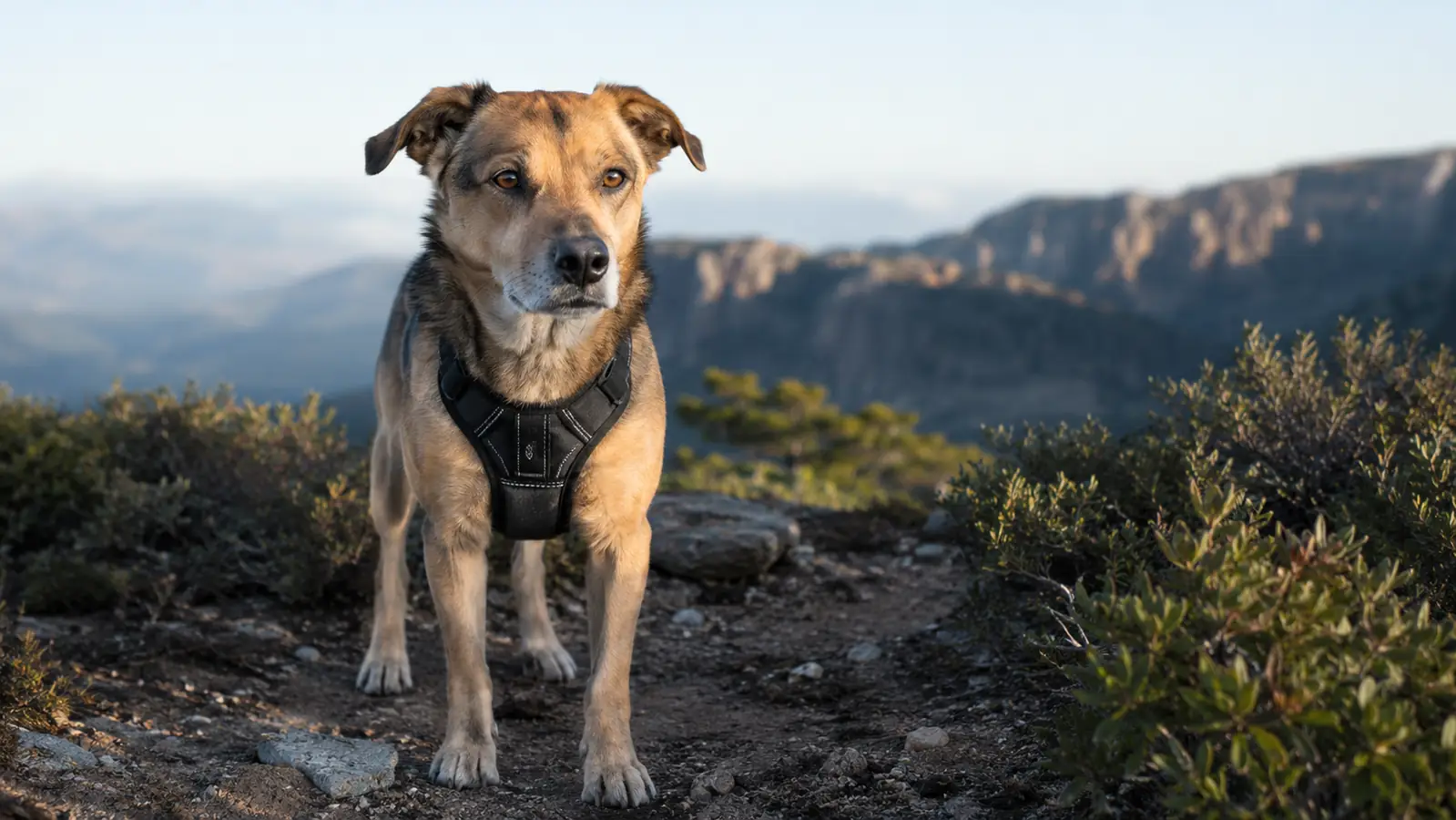
The Ruffwear Front Range harness is the oldest thing in my hiking bin. I bought it about four years ago, two weeks after Moss came home from the rescue, back when he was a two year old Australian shepherd mix with a lot of opinions and no trail manners at all. He is six now, forty six pounds, about twenty one inches at the shoulder, and the harness still hangs on the same hook by the back door it went on that first week. Nothing on it has broken. That is either a good sign for the harness or a sign that I am boring, and I suspect it is both.
What sent me looking was the collar. For those first two weeks I walked him on the flat collar that holds his ID tags, and every time he hit the end of the leash the nylon went tight and his head came up. He did not yelp and he did not hurt himself. But I did not like the sound of it, and I did not like how the whole thing felt in my hand. So I read a stack of listings, asked two people at the trailhead what their dogs wore, and ordered the Front Range in Medium. That was the entire sum of my research.
The Quick Verdict
Four years, one dog, and most of my Cascade day hikes on a single harness with nothing broken. I dock it for hand wash only care and for how much trail debris the webbing collects.
Amazon Check Today's Price →Four years in and I have never had a reason to replace it
The sizing chart on the listing is worth two minutes with a tape measure. Moss measured 28 inches around the chest and the Medium has not moved since the first evening.
Amazon Check Today's Price on Amazon →How I've Used It
Fitting took about ten minutes on the first evening. I slid it over his head, worked the straps down, checked that the padded sections sat flat against his chest instead of bunching up behind his front legs, and walked him up and down the driveway a few times. Moss measured 28 inches around the chest at the time. I have not touched the adjustment in the four years since, apart from one small seasonal change I will get to. Not once through two coat blowouts a year and one bath he did not enjoy.
Where it actually gets used: every hike short enough that Moss does not need to carry his own water, which for us means anything under about five miles. That is most Saturdays from spring through fall. It is also the harness for every snowshoe outing in winter. The leash clips to the V-ring on the back. Moss still wears his flat collar with the tags, but on a trail the leash does not touch that collar anymore, and it has not since that first month.
Before we leave the driveway I do the same two finger check every single time. Two fingers under each of the main body straps to confirm nothing is pinched, then a quick tug on the back ring to make sure the whole shell is sitting level rather than twisted off to one side. It takes about eight seconds. The one morning I skipped it, because I was trying to get out of town ahead of the weekend traffic, we got about half a mile up the trail before I noticed the right side had ridden up over his shoulder blade. Nothing happened. I stopped, straightened it, and we carried on. But it taught me that the check is faster than the correction, and now I do it in the driveway whether I am in a hurry or not.
On the longer days, the ones over five miles, and on the one or two overnight trips we do each summer, Moss wears his Ruffwear day pack instead and the leash clips to the pack's own leash point. So the harness is not on every single mile. It is on most of them, and it is the piece I reach for without thinking about it.
What the Two Leash Points Are Actually For
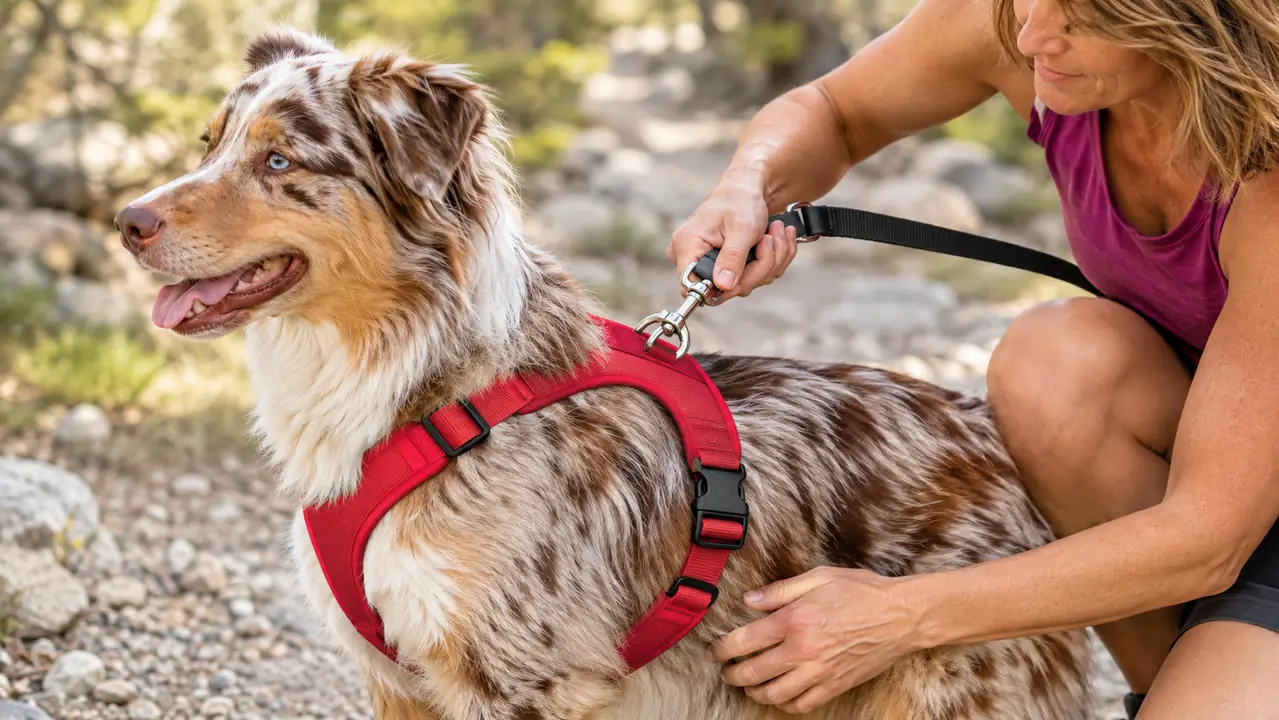
The back V-ring is the default and it is where the leash lives about 99 percent of the time. It sits high, between the shoulders, and it keeps the leash out from under his feet on descents. That matters more than I expected it would when we are picking our way down loose rock with me on trekking poles and him pretending he is a mountain goat. With a collar, the leash drops straight down under his chin and he steps over it every fourth switchback. With the back ring it stays clear of his legs the whole way down, and I am not stopping to untangle him while balancing on rubble.
The chest loop is for one specific situation. I am not a trainer and I am not going to tell you it stops a dog from pulling. But on the two or three days a season when Moss decides a deer is the most interesting thing in Deschutes County, I clip to the chest loop and it turns him sideways instead of letting him lean forward into the leash. That is enough for me to get his attention and get us moving again. It is a five minute tool, not a training program.
So if you are shopping for a harness to fix pulling, this is not that conversation, and I would rather say so than sell you something it cannot do. A chest clip helps you steer. It does not teach your dog anything. After four years with the same dog I can tell you the thing that taught Moss to walk on a loose leash was repetition on the same tired trail, not a piece of hardware.
Fit, Adjustment, and What to Check Before You Order
The closure is pull on, meaning it goes over the head. There is no buckle to snap and nothing to clip around his chest. That took me one evening to get used to and it has not bothered me since, but it is worth knowing going in if your dog does not like things passing over his ears.
The straps adjust at several points along the body and the shell is foam padded rather than bare webbing, so pressure sits on a wider surface than a plain strap would give you. Ruffwear lists the weight at 5.92 ounces, which is close to nothing in the bottom of a day pack. The reflective trim is a real strip rather than a token line of stitching, and there is a small dedicated loop on the back for a clip-on light. I do not own that light, so I can only tell you the loop is there and has not frayed in four years.
I got two things wrong at the start, and both were my fault rather than the harness's. I had the body straps too loose, because I was worried about it being tight on a dog I had known for two weeks, and I had the whole shell sitting further back than it should so the padded front panel pressed behind his front legs instead of across his chest. Moss did not complain. He just walked a little oddly up and down the driveway, the way he does when he is wearing something unfamiliar. Ten minutes with a mirror in the hallway and a second pass at the straps fixed both problems, and the fit has not needed touching since apart from the winter notch.
Order by the tape measure, not by the word Medium. Moss is 46 pounds at 28 inches around the chest and the Medium fits him with room to adjust either direction. A dog with a much deeper chest than his is a different conversation, and the chart on the listing is a better guide than my guess or anyone else's.
Four Years of Wear: What Held Up and What Didn't
Nothing has broken. The webbing has not frayed through, the padding has not split, the V-ring is still round and still seated, and the stitching at the stress points is intact. I have washed it by hand maybe six or eight times and it has come back the same shape each time. For a piece of gear that gets thrown in the back of the Outback and left there for days at a time, that is a fair record.
The care instructions say hand wash only, and that is my main grumble with it. It cannot go in the machine with the rest of the dog laundry, so it gets rinsed in the utility sink with a soft brush and hung over the back steps to dry. In late summer the webbing picks up burrs and fine dust and the padding holds grit, so a quick rinse turns into a ten minute job with a stiff brush. Skip it for a whole season and you will feel that grit against your hand every time you clip in.
Late summer is when it earns that brush. The webbing on the chest panel and along the belly strap has enough of a woven texture to grab anything with a hook on it, and after a walk through the dry stuff along the edge of a trail the whole harness looks like it has grown a coat. I keep a metal comb in the cargo pocket of my own pack for exactly that reason and give the straps a pass before the harness goes back on the hook. The comb gets the burrs. The brush gets the fine dust out of the padding, and those are two different jobs on two different parts of the same piece of gear.
The exterior fabric has faded from four summers of high desert sun. That is cosmetic and I do not much care. What I care about is that the hardware has held, because a harness that lets go halfway down a switchback is a bad afternoon for everybody involved, and mine has never given me a reason to doubt it.
Snowshoe Days, Cold Weather, and the One Seasonal Adjustment
In deep winter Moss comes in with a heavier coat and I loosen the straps by a notch for a few months, then put them back in spring. That is the only adjustment the harness has needed in four years and it takes about thirty seconds on the kitchen floor.
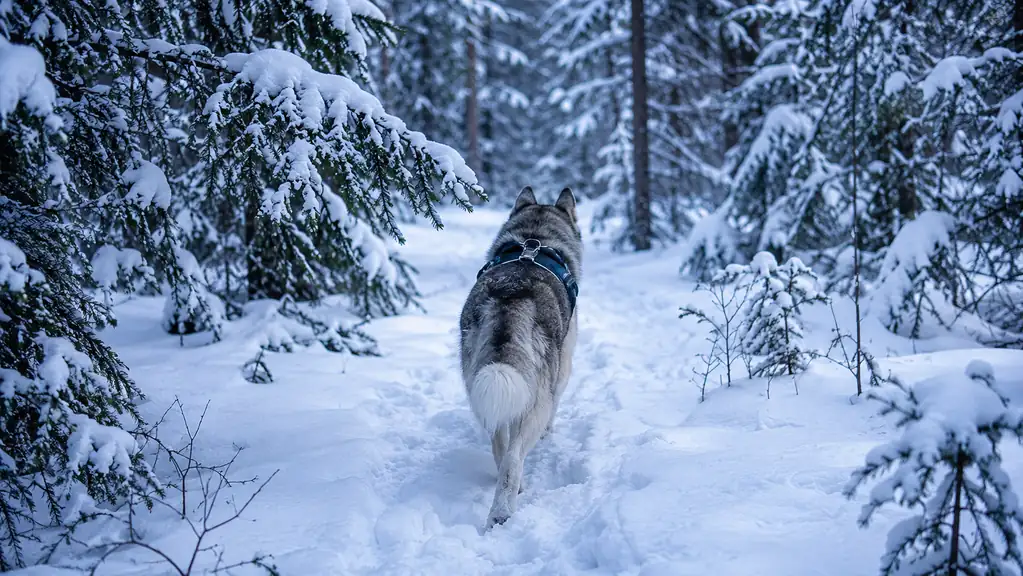
On snowshoe days the day pack stays home, because he does not need to carry water when every third step is a snowbank. The kit is the harness, the waist leash, and the collapsible bowl clipped to my own pack. The harness sits over whatever coat he is wearing well enough that I have never had to think about it, and when we stop for water it is the one piece of gear I do not have to take off him first.
Cold does change how it handles, though not in a way that has ever cost me a day. The webbing stiffens below freezing and the first clip of the morning takes a bit more thumb pressure than it does in July. It has never frozen shut and it has never refused to adjust. I keep the harness inside the car overnight rather than in the back with the rest of the gear for that reason. By the time we are a quarter mile up the trail it has warmed against him and behaves exactly the way it does the other nine months of the year.
The catch in winter is the same catch as summer. Wet, gritty snow works into the webbing and by the time we reach the car the whole thing is stiff and grubby. It gets rinsed that evening rather than left to sit, which is more discipline than I apply to most of my own gear.
What I Liked
- Two leash points in one harness: the back V-ring for normal days and a chest loop for the occasional deer
- Foam padded shell that has not rubbed Moss once in four years of Saturday hikes
- Straps set in ten minutes on the first evening and have barely moved since, apart from one winter notch
- 5.92 ounces, light enough that it disappears in a day pack
- Reflective trim plus a dedicated loop for a clip-on light
- No hardware failures across four years of trail use and back-of-the-car storage
Where It Falls Short
- Hand wash only, so it never goes in the machine with the rest of the dog laundry
- Webbing and padding collect burrs, dust and grit, and need a comb and a brush rather than a rinse
- The exterior fabric has faded from sun over four summers
- Pull on closure means it goes over the head, which some dogs will argue about
- No quick release buckle if you want it off in a hurry at the trailhead
Four years of Saturdays on Cascade trails and the only thing this harness has ever needed from me is a rinse and a stiff brush.
Who This Is For
This suits the person who hikes a handful of miles most weekends with a medium dog and wants one harness that fits, stays where it was put, and does not need replacing every other season. It suits a dog who does not mind something going over his head, and an owner willing to spend ten minutes on fit the first evening instead of guessing from a photo.
It also suits anyone who wants the option of a chest attachment without buying a second piece of gear. I have clipped to that loop maybe a dozen times in four years and I would still choose this harness again, because the days I need it are the days I really need it.
Who Should Skip It
Skip it if you want a harness you can leave on the dog around the house all day. This one is trail gear for us. It comes off in the car, and the padded shell is more than a dog needs while he is asleep on the living room rug. Skip it too if your dog backs out of over-the-head gear, because pull on means exactly that, and no amount of strap adjusting fixes a dog who has decided he is not participating.
Skip it if washing by hand is the kind of chore that will never actually happen at your house. Grit in the padding is not a safety problem, but it is unpleasant, and a harness that never gets rinsed will feel rough against your hand on every single clip in. And skip it if you are hoping the hardware will solve a pulling habit. Four years in, this harness helps me steer. It never trained my dog.
The harness I would buy again tomorrow, in the same size
Measure the chest, check the chart on the listing, and plan on ten minutes of adjusting the first evening. After that it becomes the least interesting piece of gear you own, which is exactly the point.
Amazon Check Today's Price on Amazon →