
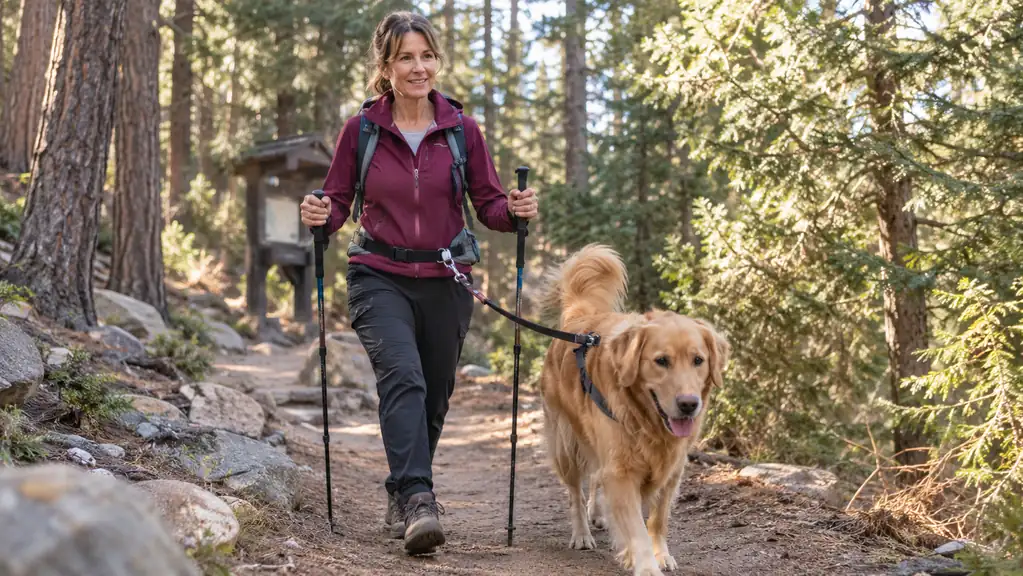
The first thing nobody tells you about a hands free leash is that the hard part is not the leash. It is the waist belt. I bought the Tuff Mutt Hands Free Leash three and a half years ago, when I started using trekking poles on my Saturday hikes near Bend, Oregon. Before that I used a plain 6 foot nylon leash in one hand, which is fine until you want both hands for poles. Moss is my 6 year old Australian shepherd mix, 46 pounds, about 21 inches at the shoulder, and he has been my only trail partner for about four years. The Tuff Mutt leash has been buckled around my waist on every hike since.
I am not a guide, a trainer or a vet. I am a 49 year old dental office manager who hikes 4 to 9 miles most Saturdays from spring through fall, snowshoes in winter and takes one or two overnight trips each summer. I bought this leash with my own money. What follows is what I would tell a friend at the trailhead, including the parts the product page does not make obvious.
The Quick Verdict
A quiet, well made waist leash for a dog who walks a little ahead and surges now and then. It is not a training tool and not the right pick for a hard puller.
Amazon Check Today's Price →The leash that keeps both hands on my poles
Three and a half years, one waist belt, and no failures. If your dog walks ahead on a loose-ish line, this is the one I reach for.
Amazon See the Tuff Mutt Leash on Amazon →How I've Used It
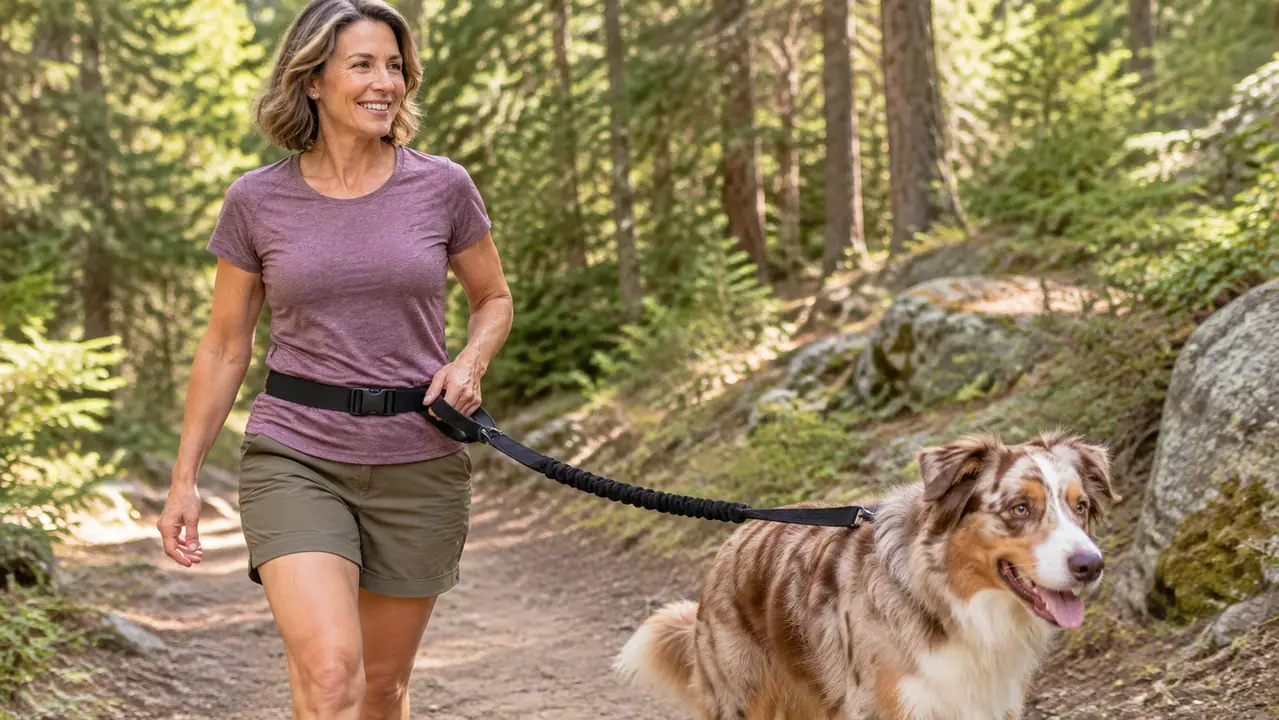
Most of my hikes are 4 to 9 miles on Cascade trails. I use trekking poles on almost all of them, which is the reason I switched to a waist leash in the first place. The Tuff Mutt leash is 48 inches long and 1 inch wide, made of nylon, and it weighs 8.78 ounces according to the listing. The waistband adjusts from 26 to 48 inches. I wear it at my natural waist, over a T shirt or a rain shell, and it stays where I put it.
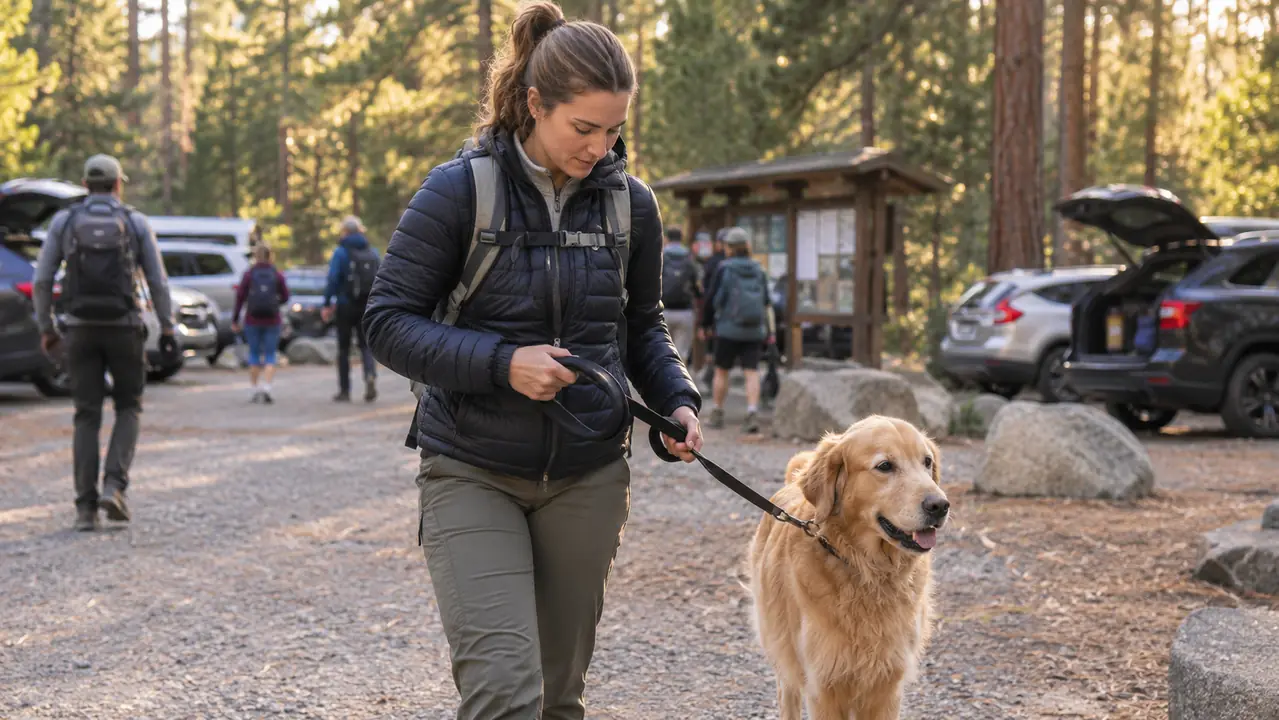
On the trail, the leash clips to the back of Moss's Ruffwear harness on shorter hikes. On pack days he wears his Ruffwear day pack instead, and the leash clips to the pack's own leash point. At a busy trailhead or in a parking lot, I take the traffic handle. That is the second handle near the clip. The rest of the time the leash runs from my waist to Moss with a little slack. He walks a few feet ahead. That is how we have done it for three and a half years.
Moss took about three hikes to settle into walking a little ahead on the bungee without tugging. He is not a hard puller. He will surge once toward a squirrel or a chipmunk and then go back to his trot. The bungee is the part that softens those small surges. The listing says the bungee stretches 4 to 5 feet. I have not measured it, but I can feel it give and then come back.
What the Listing Doesn't Tell You
The listing calls this a hands free leash. That is accurate, but the useful part is more specific. It frees both hands for poles, a map, a water bottle or a gate latch. It does not free you from paying attention. You are still attached to a dog, and the attachment is around your hips, not your wrist. On a narrow sidehill, that changes your balance a little. I noticed it most in the first week. Now I do not think about it.
The other thing nobody says plainly is that a waist leash is a fit issue before it is a dog issue. The waistband adjusts from 26 to 48 inches, so there is a lot of room in it. Too high and it rides on my ribs. Too low and it pulls at my hips on a climb. The spot that works for me is just below my belt line. I set it once and left it. If you share the leash with another person, you will reset it every time.
The dual handles matter more than I expected. The hip handle is where my hand rests when I want to keep the leash from dragging. The traffic handle near the clip is what I use at trailheads, in parking lots and on the first hundred yards when Moss is excited. It gives me a short, direct grip without wrapping the leash around my hand. I do not use it on open trail. It puts my hand too close to him for that.
The listing says the leash is detachable. Mine separates from the waist belt, which is useful when I want to rinse the webbing or when I want to leave the belt in the car. I almost never do either. The leash stays on the belt on a hook by the back door, next to Moss's harness. The snap clip still closes with a solid click. The lifetime warranty is listed. I have not needed it. Nothing has broken.
Moss took about three hikes to settle into walking a little ahead on the bungee without tugging. The leash did not train him out of pulling. It made the small pulls easier to ride out.
Where It Shines
The main win is poles. On a 7 mile day with 1,500 feet of climbing, I want both hands. A handheld leash turns every pole plant into a one armed negotiation. The Tuff Mutt leash takes that away. I clip Moss to my waist, pick up both poles and walk. That sounds small. Over 4 to 9 miles, it is the difference between a steady rhythm and a lot of small corrections.
It is also good at the awkward parts of a hike. Trailheads. Parking lots. The first stretch where Moss wants to sniff everything. The traffic handle gives me a close grip for a minute or two, and then I let him back out on the bungee. I do not have to unclip and re-clip. I just move my hand from the hip handle to the traffic handle.
On climbs, the bungee is a small cushion. Moss will get to the end of the slack when he sees something worth chasing, and the give takes the snap out of it. I still feel the direction of the pull. That is good. I do not want a leash that hides where my dog is. I want one that takes the edge off. For a 46 pound dog and a handler who is not a trainer, that is the right trade.
It has held up. Three and a half years of Saturdays, plus snowshoe days and a handful of overnights. The webbing shows trail dust. I hand wash it now and then. The clip, the belt and the handles are all still working. I have not had a stitch let go. That is the least exciting thing I can say about a piece of gear and the thing I care about most.
Where It Falls Short
The bungee is not for a hard puller. I want to be plain about that. If your dog hits the end of the leash with his whole body, a bungee leash can feel like a rubber band. You lose some of the fine control you get from a fixed length leash. Moss surges now and then. He does not lunge hard. If he did, I would use a standard leash and work on the pulling before I used this on a narrow trail.
The 48 inch length is another limit. It is enough for Moss to walk a little ahead, which is what I want. It is not enough for a dog who wants to range wide and sniff a whole hillside. On a quiet forest road I sometimes wish I had a long line for that. I do not use this leash for that job. I use it for hiking, which is a different job.
The traffic handle is short by design. That is the point. But it is not comfortable for a long stretch. If I hold it for more than a few minutes, my hand is close to the clip and my arm is bent. I use it at the trailhead and on the steep downhill sections where I want to shorten up. Then I let it out again.
The waist belt takes some getting used to. I do not notice it now. In the first week I noticed it on every climb. It is also one more thing to put on at the trailhead. A standard leash is faster. The trade is that both hands stay free, which is worth it to me. If you hate anything around your waist, this is not the leash to talk yourself into.
What I Liked
- Frees both hands for trekking poles, which is the whole reason I bought it
- The shock absorbing bungee softens a small surge without hiding where the dog is
- Dual handles: the hip handle for the trail, the traffic handle for trailheads and parking lots
- Waistband adjusts from 26 to 48 inches, so I set it once and stopped thinking about it
- 1 inch nylon webbing and 8.78 ounces, light enough that I forget it is on
- Snap clip works with gloves on and has never opened on its own
- The leash detaches from the waist belt, which makes it easy to rinse the webbing
- Three and a half years of Saturdays with nothing broken and no stitch let go
- Lifetime warranty is listed, though I have not needed to use it
Where It Falls Short
- The bungee is wrong for a hard puller and you lose some fine control
- 48 inches is too short for a dog who wants to range wide and sniff a hillside
- The traffic handle is not comfortable to hold for long stretches
- The waist belt took about a week to get used to and is one more thing to put on at the trailhead
- It can feel warm against the waist on a hot day
- No long line option, so I keep a separate lead for quiet forest roads
Who This Is For
This is for a hiker who uses poles, or who wants both hands free for a camera, a map or a water bottle. It is for a dog who walks on a loose-ish line and surges now and then, not a dog who hits the end on every step. It is for someone who hikes the same kind of 4 to 9 mile trails I do, where the leash is a tool for keeping a dog close, not a training device. It is also for someone who wants one leash for the trail and does not want to think about it again. That is how it has worked for me.
It fits a waist from 26 to 48 inches. Moss is 46 pounds and about 21 inches at the shoulder. The listing puts the breed size at large. For a dog much taller or much stronger than Moss, I would think hard about whether a waist leash is the right tool at all. The leash is only as good as the dog's habit and the handler's attention.
Who Should Skip It
Skip it if your dog pulls hard. A bungee softens a small surge. It does not fix a dog who is committed to the end of the line. Skip it if you want a long line for sniffing or a leash you can wrap around your hand for a tight heel. Skip it if you do not like a belt around your waist or if you switch handlers often and do not want to reset the fit. Skip it if you need a leash that gives you a lot of fine control in close quarters. The traffic handle helps, but a standard 6 foot leash is more direct.
I still keep a plain 6 foot nylon leash in the car. I use it around town and at the vet. I do not use it on a trail anymore. That is not because it is bad. It is because the waist leash does a better job of the one thing I need on a hike, which is keeping both hands free.
The Small Things I've Noticed
The waistband is 1 inch wide. That is wide enough that it does not dig in when Moss pulls, and narrow enough that it does not feel like a backpack belt. I wear it over a layer, not against skin. On a hot day it can feel warm. I loosen it at a water stop and tighten it again before we start. That is a small thing. It is also the kind of thing you only learn by wearing it for a few miles.
The snap clip is easy to work with one hand. I can clip Moss to the harness or the pack without taking my gloves off. I check it every time. The clip has not opened on its own. The webbing has not frayed. The only maintenance is a hand wash now and then. I rinse it in the sink, hang it by the back door and let it dry.
The detachable design is more useful than I thought it would be. I do not detach it often, but when I do, it is because I want to wash the leash without the belt or because I want to leave the belt in the car. It is not a feature I bought it for. It is one I have used. That is a fair way to judge a piece of gear.
The lifetime warranty is listed. I have not tested it. I mention it because it is part of what you are buying, not because I have a story about a replacement. The leash has not needed one. After three and a half years, that is the review.
A Standard Leash Still Has a Job
I am not going to tell you a waist leash replaces every other leash. It does not. I still use a plain 6 foot nylon leash around town, at the vet and in places where I need to keep Moss close on a short, direct line. The Tuff Mutt leash is for the trail. It is for the 4 to 9 mile day where I want both hands on my poles and a dog who walks a little ahead.
If you are choosing between this and a standard leash, the question is not which one is better. It is which job you are doing. A standard leash is simpler, faster to put on and easier to hand to someone else. The waist leash frees your hands and keeps the pull off your wrist. On a hike with poles, that is the job I need done. Around town, it is not.
The Bottom Line
If I were buying again, I would do exactly what I did: buy the Tuff Mutt leash at the same time as my first pair of trekking poles, so I never had to juggle poles and a handheld leash on a trail. For a 46 pound dog who walks a little ahead and a handler who wants both hands free, it has been the right tool. It is not a training aid. It is not for a hard puller. It is a well made waist leash that has done its job without drama for three and a half years.
If you hike with poles, this is the leash that gets out of your way
It will not suit a hard puller and it will not teach your dog to stop pulling. For a dog who walks a little ahead on 4 to 9 mile days, it has been the quiet piece of gear I never think about.
Amazon See the Tuff Mutt Leash on Amazon →