
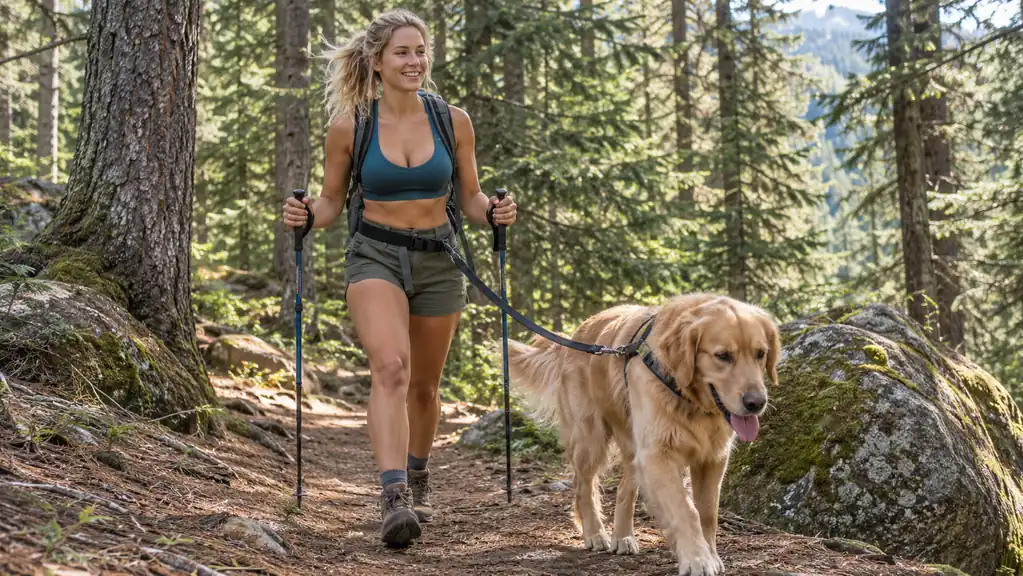
Three and a half years ago I bought a waist leash because I got tired of choosing between my dog and my trekking poles. I hike most Saturdays on Cascade trails near Bend, Oregon, with Moss, my six year old Australian shepherd mix, and on any climb worth the name I want both poles planted and both hands free. A loop of nylon around my waist solved that in about ten seconds. The Tuff Mutt Hands Free Leash is the one I bought, and it has been buckled on for every hike since, from a four mile ramble to a two night trip in the summer.
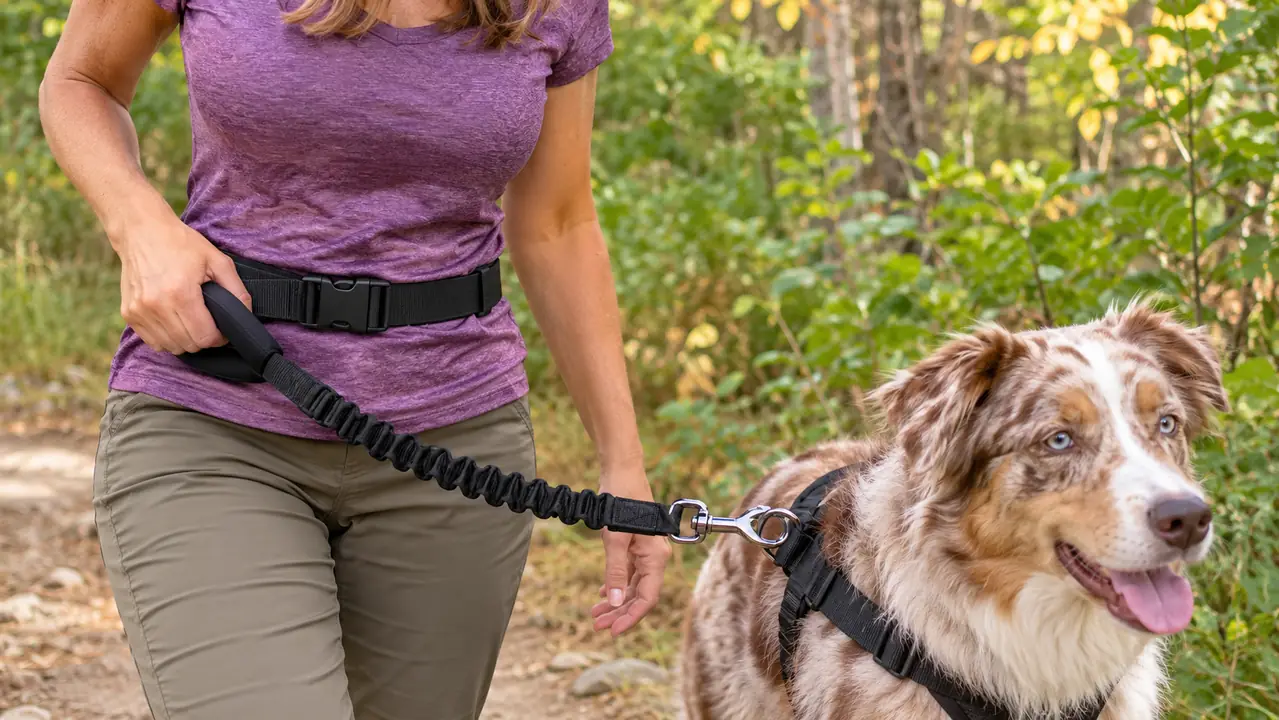
I am not a guide, a trainer or a vet. I am a dental office manager who hikes a lot and buys her own gear. Everything here came out of my own money, nothing was sent to me to try, and nobody asked me to write this. What follows is what I noticed over roughly three and a half years of trail miles, including the parts that are not flattering. The leash itself is 48 inches of 1 inch wide nylon with a shock absorbing bungee, a snap clip at the dog end, and a waistband that adjusts from 26 to 48 inches. It weighs 8.78 ounces.
The Quick Verdict
A waist leash that does the one thing I needed and then stays out of the way: it keeps both poles in my hands and gives my dog a little room on the bungee. Not the right leash for a hard puller.
Amazon Check Today's Price →Both hands on your poles, both eyes on the trail
The Tuff Mutt Hands Free Leash buckles around your waist and leaves your arms free for trekking poles, a map, or a water bottle. It has a lifetime warranty and a waistband that adjusts from 26 to 48 inches.
Amazon Check Today's Price on Amazon →How I've Used It
I bought the Tuff Mutt leash the same spring I started carrying trekking poles on longer days. Before that I used a plain 6 foot handheld nylon leash, which still lives in the car and still comes out around town. It never comes on a trail now. A typical Saturday is four to nine miles, and the leash is buckled around my waist from the moment I step out of the Outback to the moment I open the tailgate again. On winter snowshoe outings it does the same job over packed snow. On our one or two summer overnights it comes too, and on those Moss wears his day pack with the leash clipped to the pack's own leash point instead of his harness.
A normal trail day looks like this. I park, clip the snap clip to the V-ring on the back of Moss's harness, and buckle the waistband. Then I set out with a pole in each hand. Moss walks a little ahead, which took him about three hikes to settle into, and the bungee takes the small surprises out of the walk. When we meet someone coming down the trail, or another dog, I take the short handle with my left hand and bring him in close to my hip. Then I let it back out. That is the entire routine, and there is nothing to learn after the first week.
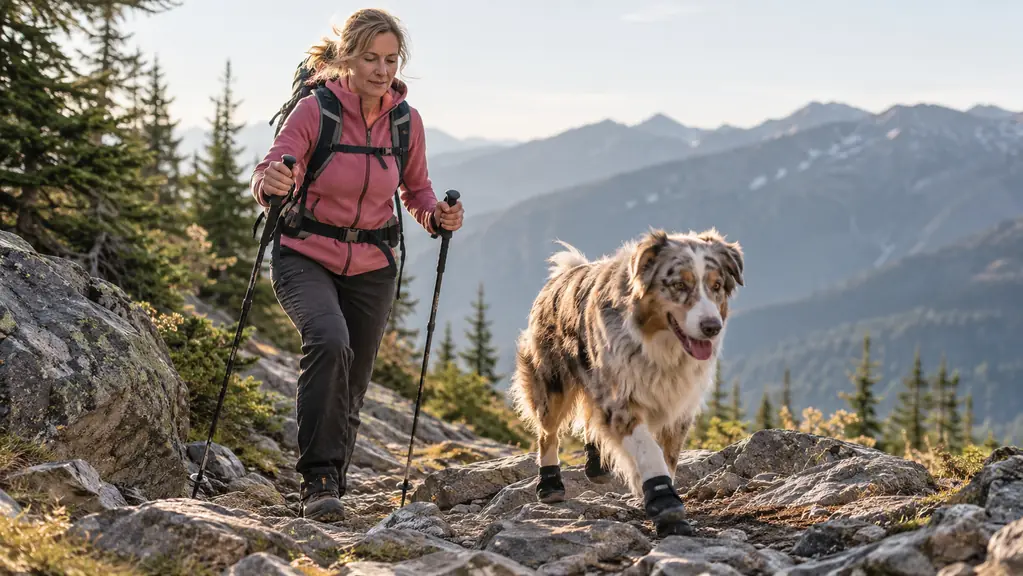
The difference from a handheld leash is not subtle, and it is not really about the dog. On a steep climb with poles, a handheld leash means one pole, or one pole plus a wrist loop, or stopping to switch hands every time the trail bends. With the leash on my waist I plant both poles on the same rhythm I would use without Moss at all. My shoulders stay square. I breathe better on the uphill. That is the honest case for the thing, and it turned out to be a bigger case than I expected when I handed over my money.
What the Bungee Actually Does on a Real Trail
The bungee stretches from 4 to 5 feet. In practice that means Moss can drop his nose to sniff something and keep moving without yanking me backward, and I can keep walking at my own pace. When he stops dead to stare at a deer, the bungee gives a stretch instead of a jolt, so what reaches my hips is a soft tug rather than a snap. I noticed that most in the first month, when he was still working out his pace against mine. It has not stopped being useful since, and it is the part of this leash I would miss first if it were gone.
The bungee is not magic and it is not a seatbelt. It makes a normal dog's pull gentler. It does not make a hard lunger safe. If your dog hits the end of any leash with real force, a bungee attached to your waist just means you get pulled from a different angle, and you will either be glad of the short handle or you will wish you had sorted out the pulling first. I say that as someone whose dog is 46 pounds and only mildly interested in most things. Moss pulls toward wildlife on the odd day, and on those days I use the short handle and keep him at my knee, not the bungee.
The other place the stretch shows up is a steep downhill. Going down, a bungee can feel like it is lagging behind you, and I shorten up with the short handle and walk him closer. That is not really a flaw in the leash as much as it is physics. Anything with give is going to feel different when gravity is helping your dog instead of you.
It makes a normal dog's pull gentler. It does not make a hard lunger safe.
The Two Handles, and When I Reach for Each
There are two handles. The hip handle sits near the waistband and gives you a short, firm hold with the leash gathered into your fist. The other handle sits closer to the dog end and lets you bring him right up beside you. On open trail I use neither and let the bungee do its job. At a busy trailhead, in a parking lot, and on the stretch where the trail crosses a gravel road, I take the dog-end handle and keep Moss at my knee. That is maybe five percent of any hike. It is also the five percent that would otherwise be the annoying part.
The leash has a detachable design, meaning the waistband portion and the leash portion come apart. I have used that exactly as often as I have needed to, which is to say I have unclipped it to rinse the whole thing in a bucket at home and then clipped it back together. If you also want to walk your dog on an ordinary handheld lead with the same piece of gear, the detachable design is what makes that possible without buying a second leash. That is not how I use it, but it is there.
One morning at a trailhead with a full parking lot, a truck was backing out while a family unloaded two dogs. Moss was on the dog-end handle, at my knee, while I stood still and let the whole thing sort itself out. That is the scenario I bought this for as much as the poles. A leash that lets you gather several feet of nylon into your hand in one motion is worth having in a parking lot, and no handheld lead I have used makes that as easy.
Fit, Weight, and the Waistband
The waistband adjusts from 26 to 48 inches, which covers a wide range of bodies. I wear it snug over a thin layer and let it out a notch over a rain shell and a fleece together. It sits at my hips rather than at my natural waist, which is where I want a pull coming from. It does not ride up when I climb and it does not slide down when I stop to filter water. The 1 inch wide webbing is soft enough that a nine mile day does not leave a mark, and I have never had to stop mid hike and readjust it.
It weighs 8.78 ounces, which is about the same as a small apple and not something I notice on my hips. The part that matters more is what I am no longer carrying in one hand all day. On a long day, a handheld leash means hours of one arm sitting slightly out of rhythm with the rest of me. That is the quiet tax a waist leash removes, and I did not appreciate how much of it I was paying until I stopped.
The listing states a lifetime warranty. I have not needed it. Over three and a half years nothing has broken: no stitching has let go, the snap clip still opens and closes with a firm click, and the bungee has not gone slack. I hand wash it now and then in a bucket with a little soap and hang it over the porch rail to dry. The nylon has faded some from sun and dust, the same way everything out here fades.
What It Replaced, and What It Did Not
Before this I used a plain 6 foot handheld nylon leash, and before that, for the first two weeks after Moss came home from the rescue, just his flat collar. That collar is the only alternative I have actually used on a walk, and it is why I stopped clipping a leash to a collar on trails. A collar puts the pull at his throat, and on a climb he was pulling constantly. The harness moved the pull to his back and the waist leash moved my end of it off my wrist entirely. Three pieces of gear, each one solving a different part of the same small problem.
What it did not replace is the handheld leash for town. The 6 foot lead still comes out for the walk from the car to the office and around the neighborhood in the evening. The waist leash is a trail tool for me, not an everyday leash. If you want one piece of gear to do both jobs, the detachable design makes that possible, but I would rather not be that clever about it.
Where It Falls Short
The bounce is the main one. Even with a calm dog, the bungee gives a slight spring on every stride, and on a long downhill it can feel like the leash is walking behind you. Some people love that feel and some do not. I mostly do, and I still shorten up with the short handle every time the trail drops.
Second, it is not a training tool and it is not a fix for a dog who pulls hard. A waist leash puts the pull at your center of gravity, which is a better place to absorb it than your shoulder, but a strong lunge can still move you. If your dog is big and untrained on a lead, sort out the pulling first. Same for a dog who reacts to other dogs at close range. The leash gives you a handle, not a plan.
Third, and this is small: at a crowded trailhead you are managing a loop of nylon around your waist while also managing a dog, and the short handle helps but the whole setup is busier than a plain lead. It took me a couple of weeks to stop fumbling it, and I still occasionally step into my own leash when I turn around too fast.
What I Liked
- Keeps both hands free for trekking poles
- The bungee takes the jolt out of a normal dog's pull
- Two handles give a firm hold at trailheads and road crossings
- Waistband adjusts from 26 to 48 inches and stays where you put it
- Lifetime warranty, and nothing has broken in three and a half years
Where It Falls Short
- The bungee bounce is noticeable on steep downhills
- Not a fix for a hard puller or a reactive dog
- Busier than a plain leash to handle in a crowded parking lot
Who This Is For
This suits a hiker who wants both hands back. If you carry trekking poles, a camera, a map, or a water bottle in one hand, and your dog already walks reasonably on a lead, the Tuff Mutt Hands Free Leash is the piece of gear that ends the constant hand switching. It also suits anyone who covers real miles on open trail where a dog can range a few feet ahead on a bungee without tangling in brush. And it suits a mid sized dog. Moss is 46 pounds, and the kind of pull he produces is exactly the kind this leash is built to absorb.
Who Should Skip It
Skip it if your dog lunges hard, if your dog reacts to other dogs at close range, or if your dog weighs considerably more than you do. A waist leash does not train anything, and the bungee will not rescue you from a serious pull. Skip it too if your trails are tight and brushy, where a dog a few feet ahead on a stretchy line is a snag waiting to happen, or if you want a leash you can simply open your hand and drop. I am fond of mine on open Cascade trail. It would be the wrong leash on a crowded boardwalk.
Three and a half years on my waist, and I would buy it again
If you hike with poles and a dog who already walks decently on a lead, this is the one piece of gear that changed how the day feels. Check the current price and the size options on Amazon.
Amazon Check Today's Price on Amazon →