
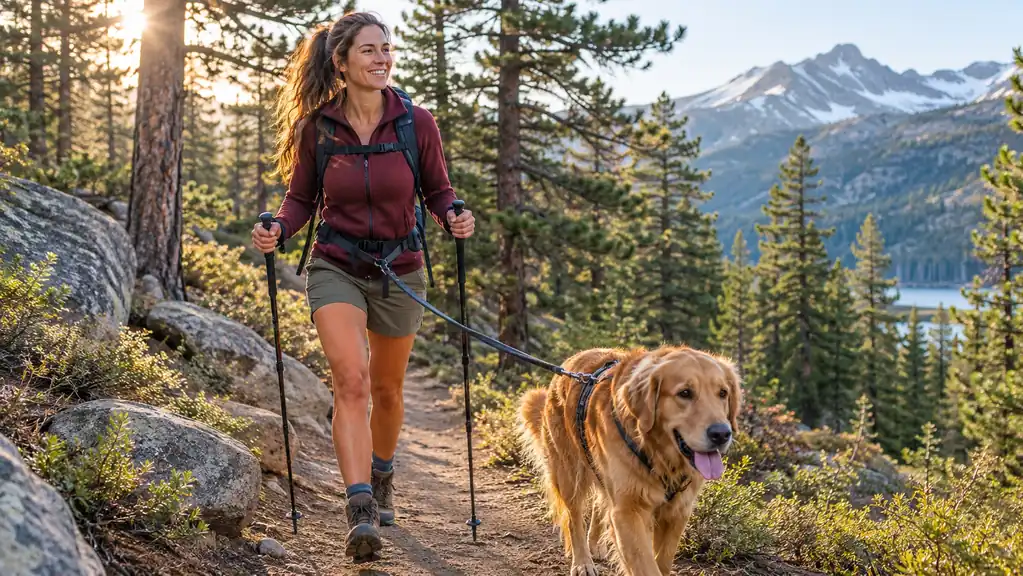
Three and a half years ago I hiked a six mile stretch of trail outside Bend with a plain six foot nylon leash looped around my wrist and a pair of trekking poles I could not really use because of it. I bought the Tuff Mutt Hands Free Leash the following week. I still own both leashes. The handheld one lives in the Subaru door pocket now, and the waist leash goes on every hike I take with Moss, my six year old Australian shepherd mix, who is 46 pounds and about 21 inches at the shoulder. This is the comparison I wish I had read before I bought either of them.
The short answer: for hiking, the Tuff Mutt waist leash is the one I reach for, and I have reached for it every Saturday from spring through fall for three and a half years. For a walk around the block, a parking lot, or the trip from the car to the vet's door, the plain handheld leash is simpler, and I still use it. The mistake is buying one and expecting it to do both jobs well. It will not.
| Tuff Mutt Hands Free Leash | Standard Handheld Leash | |
|---|---|---|
| Hands on the trail | Buckles around the waist, so both hands stay on the trekking poles | One hand is on the leash for the whole hike |
| Close control in a crowd | Second handle near the collar pulls the dog in short without unclipping | You gather six feet of slack by hand and hold it |
| Room to sniff | Bungee tops out around 4 to 5 feet | Six feet, fixed, all day long |
| Sudden lunge | Bungee takes the sharpest part of the pull before it reaches your hips | Nothing between you and the jolt |
| Fit | 1 inch wide nylon waistband, adjusts 26 to 48 inches | No fit to set, just a loop for your hand |
| Weight carried | 8.8 ounces sitting at the hip | A few ounces swinging from one hand all day |
| Around town | More gear than a walk around the block needs | Goes in a coat pocket and can be handed to anyone |
| Care | Nylon, rinsed and hung when it gets muddy | Rinse and hang, nothing to adjust afterward |
| Warranty | Lifetime warranty from Tuff Mutt | Whatever the store offered, often nothing |
| Best for | Hikers with poles, runners, long days out | Short walks, town errands, a spare in the car |
Where the Tuff Mutt Hands Free Leash Wins
The poles are the whole reason I switched. Most of the descents on the Cascade trails I hike are loose rock and dust, and on those I want both hands on my poles with my weight back over my heels. With a handheld leash that is not possible, because one hand is permanently occupied holding six feet of nylon with 46 pounds of dog at the other end. Buckled around my waist, the leash sits at my hip and both hands stay free. I did not understand how much of my attention the leash had been taking until it stopped taking it. The clearest version of that was a Saturday last October on a descent I have walked a dozen times, a grade where you want your weight back and your poles planted ahead of you. With the handheld leash that quarter mile meant one pole, or no poles, and a hand closed around nylon. With the waist leash I planted both poles, took it slow, and Moss picked his own line beside me. Nothing dramatic happened, which is the point. There was simply one less thing to think about.
The bungee is the second thing. The listing says it stretches 4 to 5 feet and cushions a sudden pull, and that matches what I feel on the trail. When Moss stops dead because there is a squirrel on a log, the stretch takes the sharpest edge off it before it reaches my hips. It is not a fix for a dog who has never been taught not to lunge, and I would not pretend otherwise. It just turns a jolt into a lean.
The second handle sits closer to the collar, and I use it more than I expected to. At a busy trailhead, or when another dog is coming up the trail and I want Moss beside my knee instead of out in front, I grab that handle and he is on a short lead in about a second. Then I let go and he is back out on the bungee. One hand, no unclipping, no wrapping the leash around my fist the way I used to with the handheld one. On steep downhills I shorten up on that same handle and let him take the slope slower instead of letting the grade push him.
The fit is a set and forget thing. The waistband is 1 inch wide nylon and adjusts from 26 to 48 inches, and the whole leash weighs 8.8 ounces. I set it to my waist once in the driveway, and I have not adjusted it since. On a warm day I forget it is there. On a cold day it goes over the rain shell without complaint. On snowshoe outings in winter it buckles over the shell and the snow pants and I do not notice the difference. On the handful of overnights I take each summer, the leash clips to the leash point on Moss's day pack instead of his harness, and the waistband still sits exactly where it always sits. That sameness is worth something: the same buckle, the same handle at my hip, whether I am on dirt, on snow, or walking into camp at dusk. The listing also carries a lifetime warranty from Tuff Mutt, which I have never had to use, and after three and a half years of weekly use there is nothing to report beyond a little dust and a rinse now and then.
Where a Standard Handheld Leash Wins
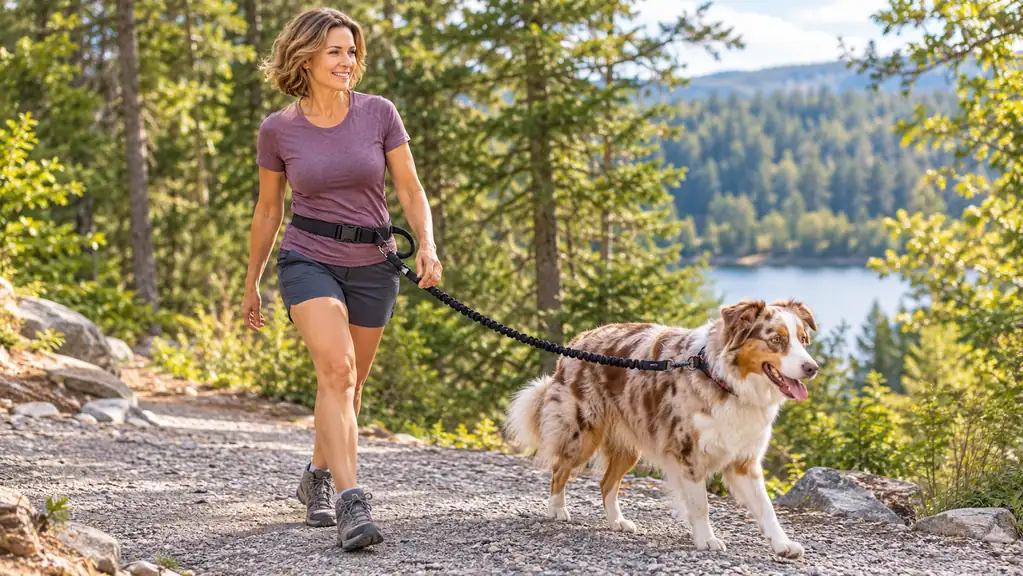
A fixed leash gives the dog more room. The Tuff Mutt tops out around 4 to 5 feet when the bungee is stretched, and it pulls back toward you the moment the dog eases off. A plain six foot leash is six feet all the time. Moss likes to step off the edge of the trail to sniff at a fallen log or a patch of bear grass, and on the handheld leash he gets to the end of it and stays there as long as he wants. On the waist leash he gets there and the bungee gently says come back. That is a small thing that adds up over nine miles. It adds up differently depending on the dog, too. Moss is a sniffer. He wants his nose in every patch of bear grass and every scuffed bit of dirt where another dog has passed, and a fixed six feet lets him do that at his own pace without me steering him. On the waist leash I am always, gently, the thing that ends the sniff. Three and a half years in, I have made my peace with that trade, but it is a real trade and I would not talk anyone out of noticing it.
The handheld leash is also just simpler when the job is small. It goes in a coat pocket. There is no waistband to buckle, no strap to thread, and nothing to adjust if I hand it to someone else for a minute, which happens at the vet's front desk and in the parking lot at the trailhead when a stranger wants to say hello to Moss. For the ten minute walk around my neighborhood, or the walk from the car to a door, a waist leash is more gear than the errand needs, and I say that as someone who likes the waist leash. The handheld one has no bounce either, which matters if your dog is a hard puller who hits the end of the leash at a run. The bungee is the reason I like the Tuff Mutt and it is also the reason I would not hand it to someone with a dog who yanks.
There is a mud and rain angle too, and it is the least exciting one. A plain strip of nylon goes in the basin and hangs on the porch rail and is dry by morning. The waist leash has a waistband and hardware to rinse around, and it stays damp a little longer on a wet week. None of that is a reason to avoid it. It is a reason I keep the simple one in the car for the soggy stretches of the year, when the trail is a mud pit and the walk is short anyway.
Both hands on the poles, the dog on your hip
This is the leash that has gone on every Saturday hike for three and a half years. 48 inches of 1 inch nylon, a bungee that takes the edge off a pull, and a waistband that adjusts from 26 to 48 inches. 8.8 ounces, lifetime warranty.
Amazon Check today's price on Amazon →The Changeover Took About Three Hikes
Moss did not understand the waist leash on the first outing. He had spent the first stretch of his hiking life on a handheld leash and he expected to feel me at the end of it. The first hike was a four mile out and back on a Saturday in early spring, and he spent most of it walking near my left heel with his ears back, checking over his shoulder to see where I had gone. The second was a little longer, and he started to range out in front and then drift back, testing how far the bungee would let him go before it told him no. By the third hike he had it figured out. He walks a little ahead, the bungee takes up the slack, and when I stop he stops, because the stretch pulls him up short without either of us saying anything about it.
One habit I had to unlearn: with the handheld leash I used to wrap the extra slack around my fist when I wanted him close, which is hard on your hand and worse if the dog bolts. The collar handle on the waist leash replaced that entirely, and it did it without me having to think about it, which is the only reason the habit broke. I did not expect that when I bought it. The other thing I had to get used to is that the leash is attached to my body, not my hand, so my body steers him whether I mean it to or not. If I turn to look at a view, Moss feels the shift and turns with me. That felt strange for a couple of weeks. Now I use it, especially where a trail bends and I want him on the inside of the curve rather than out over the edge.
What I Would Check Before You Buy Either
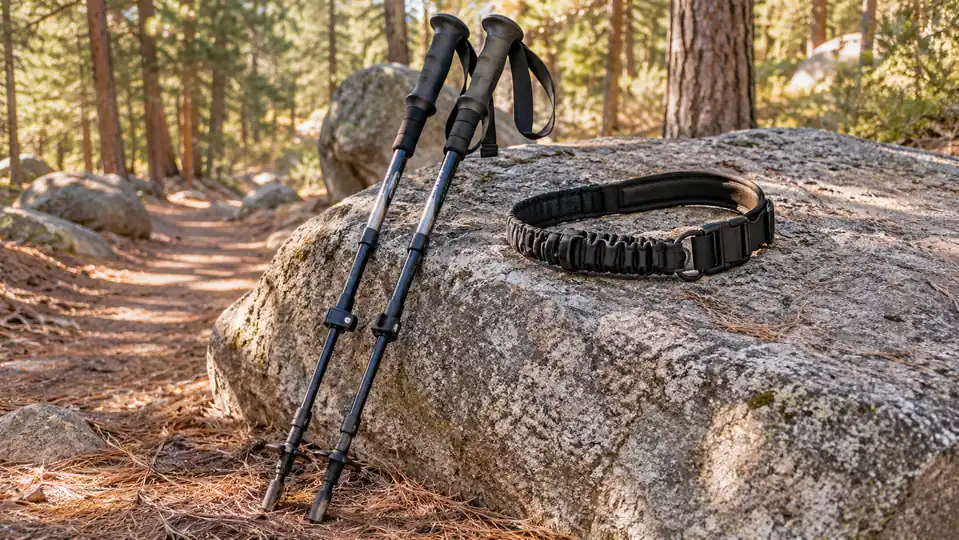
Measure your waist before you order. The Tuff Mutt adjusts from 26 to 48 inches, which is a wide range, but it does have ends. I measured with a cloth tape over the rain shell I hike in from October through April, not over a t shirt, because that is the layer the band actually sits on for half my hiking year. My measurement landed comfortably inside the range and I have not touched the adjustment since. If yours lands near either end, check before you order, because no amount of liking the idea will fix a band that does not close.
Be honest about your dog's pulling habit. The bungee softens a sudden stop. It does not train your dog, and it does not hold a dog who launches at every passing bike. If your dog hits the end of the leash at full speed, a fixed leash and some training work are a better place to start, and I would say the same thing about any bungee on the market. The Tuff Mutt listing puts the size at large breed, and Moss at 46 pounds with a 28 inch chest girth is comfortably inside that. He pulls some when a deer crosses the trail, and for that amount of pull the stretch is exactly right. A dog that pulls hard all day is a different conversation.
And ask whether you actually use your hands on the trail. If you carry trekking poles, a camera, or a water bottle you are tired of juggling, the waist leash earns its place in about one hike, and you will wonder why you waited. If you walk mostly on pavement with your hands in your pockets, it will feel like extra gear for no reason, and the plain leash you already own is the better tool.
Two smaller things worth knowing. The listing calls it a dual handle, detachable design, and I have used both handles a great deal but I have never had a reason to take anything apart, so I will not pretend to have an opinion on that half of it. What I can tell you is that the snap clip has gone on and off Moss's harness four or five times a week for three and a half years and it still closes with the same firm click it did the first week. The other thing is the attachment point. Moss wears his harness on every trail hike and the leash clips to the V ring on the back, or to the leash point on his pack on the days he carries water. I have not clipped a leash to his collar on a trail since his first two weeks with me, and I would not start now, whatever leash is on the other end.
Who Should Buy Which
Buy the Tuff Mutt Hands Free Leash if you hike or run with poles, if your hikes run long enough that a leash in one hand becomes a nagging annoyance, or if you want a second handle for pulling your dog in close at a crowded trailhead without unclipping anything. Buy it if your dog pulls some but not catastrophically, and if you want something that sits at your hip and lets you forget about it for the rest of the day.
Keep a standard handheld leash too, honestly. Mine lives in the car and gets used several times a week for the short walks, the vet, and the neighborhood loop. It is not a burden to own both, and each one is better at its own job than the other could ever be. If you can only buy one and you hike more than you walk around the block, buy the waist leash. If your trails are short and your dog is a hard puller, buy the handheld one and put what you save toward a harness with a proper front clip.
Three and a half years, one waist leash, no complaints
I have replaced nothing on it and rinsed it a handful of times. If your hikes look anything like mine, this is the one that ends up by the back door with the harness.
Amazon See the Tuff Mutt waist leash on Amazon →