
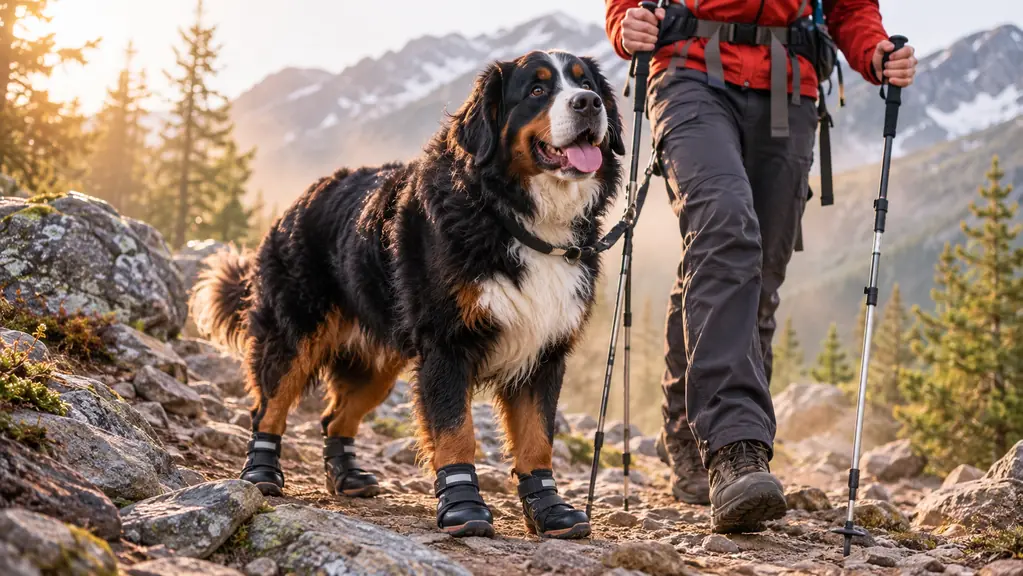
Most dog boot reviews read like the listing wrote them. Mine will not. I am Kari Brennan, 49, and I manage a dental office in Bend, Oregon. I hike 4 to 9 miles on Cascade trails most Saturdays from spring through fall, with a few snowshoe days in winter and one or two short overnights each summer. My dog is Moss, a 6-year-old Australian shepherd mix, 46 pounds and about 21 inches at the shoulder. I bought the Ruffwear Grip Trex Dog Shoes with my own money 18 months ago. They are the newest piece of gear in a small kit I have built around one dog and a lot of Saturdays. I did not buy them for every trail. I bought them for rough lava rock, hot exposed rock in summer, and packed icy snow.
Here is the short version before the long one. The shoes have earned a place in my pack, but not in the way the product page might lead you to think. They are not a four-boot set. They are not something I put on Moss every time we leave the trailhead. And they are not a fix for a dog who hates having his feet handled. I bought two pairs on day one because the listing is clear that the product is two boots. I have had a loose strap start to twist once, and it was my fault. If you want the honest review, including the parts that do not fit a clean five-star story, keep reading.
The Quick Verdict
A well-made trail tool for rough ground, sold two boots at a time, and only worth it if you will practice the straps and reserve them for the surfaces that need them.
Amazon Check Today's Price →The boot I reach for on lava rock, not on every hike
If your dog picks his way across hot or sharp ground, the Grip Trex is the pair I have trusted for 18 months. Check the size chart first, and remember that the listing is two boots, not four.
Amazon See the current listing on Amazon →How I've Used Them
I bought the Grip Trex 18 months ago. At that point Moss and I had been hiking together for about two and a half years. I had a harness, a hands-free leash, and a collapsible bowl. I had never owned dog boots. I bought two pairs at once because the listing says 2 count, and I wanted all four paws covered. That detail is easy to miss when you are scrolling on a phone. It is the first thing I would tell a friend who asked me about these shoes.
Our use is narrow by design. On soft dirt trails, Moss is barefoot. On a normal Saturday hike in the Cascades, the shoes stay in the pack. I put them on for rough lava rock, for long stretches of hot exposed rock in summer, and for packed icy snow in winter. That is maybe a handful of hikes a month in season, plus snowshoe days. I do not leave them on for the whole loop if the trail changes. I stop, take them off, and let his paws breathe on the soft sections. That is not a knock on the shoes. It is how I use them. A tool that tries to do every job usually does none of them well.
The first sessions were in our back yard. Moss high stepped around for about three short sessions before he walked normally. I did not force a long hike on day one. I let him get used to the feel on grass, then on gravel, then on a short stretch of trail. If your dog does a full-body flop the first time you put them on, that is normal too. Go slower than you think you need to. The shoes will still be there next weekend. A bad first mile can set you back a month.
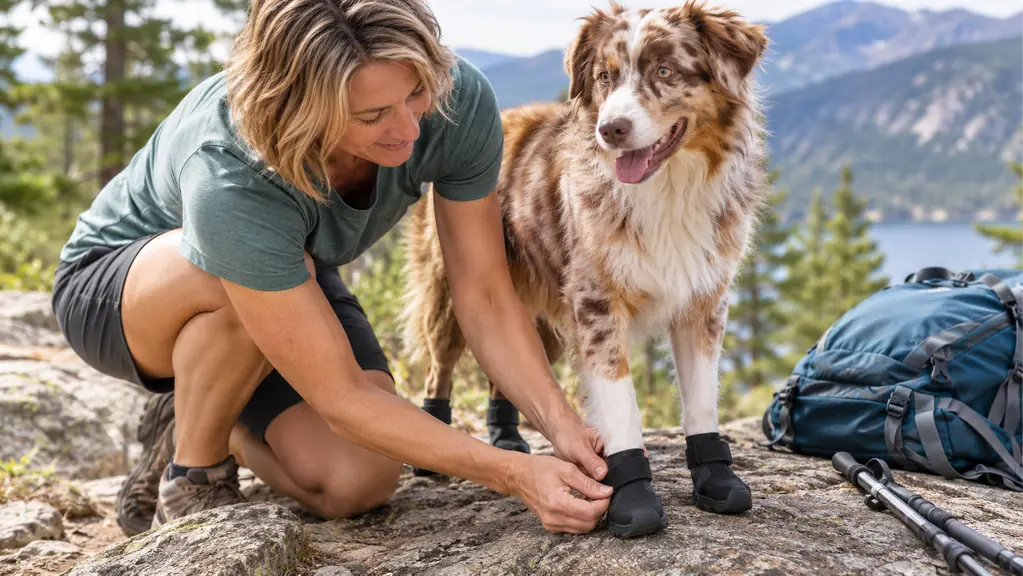
I put them on two paws at a time now, front first and then back, because that is the order Moss stands still for. The whole job takes me about three minutes. It took closer to ten the first month. Both pairs live in a stuff sack near the top of my pack, next to the bowl, so I am not digging around at the base of a rocky section with a dog who wants to keep moving. That small habit has saved me more than one slow, fumbling stop.
The Sold-in-Pairs Detail Nobody Mentions at Checkout
The listing title says 2 count. The product is two boots. Not four. I knew that because I read the listing twice, and I still bought two pairs. If you have a four-legged dog and you want all four paws covered, you are buying two units. I would rather say that plainly than have you find out after the first box arrives. It is not a trick. It is just a detail that gets lost when you are comparing five tabs and a size chart.
I measured his paw the way the Ruffwear sizing page told me to, with a ruler and a sheet of paper on the kitchen floor, and I checked it twice because I did not want to order the wrong size and wait on a second shipment. The 2.50 in size is what the chart pointed to for his paw width. If you land between two sizes, measure again before you click. Returning boots because you guessed is a slow way to spend a Saturday you could have been on the trail.
The other detail is that the shoes are hand wash only. I rinse them after a dusty or snowy day and set them by the door to dry. I do not put them in the washing machine. I have not had a strap fail, a seam open, or a sole peel. After 18 months, the uppers look used, because they are used. The ripstop upper has held up to grit and to the inside of my pack. I have not lost one. That sounds like a low bar, but with dog boots, it is not. A boot that comes off on a rocky trail is worse than no boot at all.
Fit Is the Whole Review
The size I bought is 2.50 in. Ruffwear has a sizing chart, and I used it. The fit is the part that decides whether these shoes work for your dog. A boot that is too loose can twist. A boot that is too tight is not something I would leave on for a long climb. I check the straps before we start and again after the first quarter mile. The closure is hook and loop, and it takes practice to get the same snugness on all four paws. The first few times, I was slow. Now I can do it without thinking, but I still check.
I check them in the same order every time: front left, front right, back left, back right. At the quarter mile I stop, lift each paw, and look at whether the boot is sitting straight. I also press a thumb against the strap to feel whether it has crept loose. That sounds fussy. It takes about thirty seconds, and it is the difference between a boot that stays on and a boot that ends up in my hand halfway up a slope. Moss stands for it now because he knows the walk continues after.
The straps are the one part I would tell you to practice at home. Put the boots on in the driveway, walk the dog around, and see if any boot rotates. If one does, stop and adjust it before you get to a rocky section. I have had a loose strap start to twist, and it was my fault, not the shoe's. I did not lose the boot. I noticed it, fixed it, and moved on. That is the honest version. The shoes are not self-adjusting. They depend on you kneeling down and doing the work.
The upper is polyester and rubber, according to the listing, and the sole is rubber. I am not going to pretend I can judge the rubber compound. What I can tell you is that on rough rock, Moss moves more like himself than he does with bare paws. He stops less. He picks his line instead of mincing. That is the only performance claim I will make. I have not measured his gait, and I am not a vet or a trainer. I am a person who watches her dog on the trail and notices when he looks more comfortable.
Eighteen months, two pairs, four paws, and not one boot lost. That is the number I care about.
What They Do Well on Rough Ground
The listing says the ripstop upper blocks heat, snow, salt, and moisture. I cannot verify the heat blocking in a lab. I can tell you that on hot exposed rock, Moss does not hold his feet up the way he does without them. On packed snow, the shoes keep snow from balling up between his pads as quickly. On lava rock, the rubber sole gives him a layer between his paws and the sharp edges. That is what I wanted. It is not a medical device, and I am not saying it prevents anything. It is a barrier, and on those surfaces, a barrier is the point.
The stay-on fit is the other thing that surprised me. The listing calls it a stay-on fit even during zoomies. I do not let Moss zoomie on lava rock, but I have watched him do a short burst on a sandy stretch with the boots on, and they stayed put. The hook and loop straps, when they are snug, hold. I check them. I do not trust any strap blindly. But I have not had a boot come off mid-stride. For a product sold in pairs, that is the whole game.
They are also light enough that Moss does not hike like he is wearing anchors. The listing says 4 ounces. I do not weigh them before every hike, but I notice when they are in the pack. They are not the heaviest thing I carry. On a long day, that matters. A boot that makes a dog high-step for nine miles is not a boot I would bring back.
Where They Fall Short
They are warm. I do not use them on a hot day unless the ground is the reason. If we are on a shaded dirt trail in July, Moss is barefoot. If we are on exposed rock, I put them on and I watch him. I take them off at water breaks. The shoe is not breathable in the way a mesh trail runner is. The listing says breathable, and I am sure it is more breathable than a rubber boot, but it is still a closed layer on a dog's foot. That is a tradeoff, not a flaw.
The straps take practice. I said it earlier, and I will say it again because it is the main reason someone returns these. If you are not willing to kneel down and check four straps, these are not for you. A loose strap can twist. A twisted strap is annoying for the dog and a stop for you. The good news is that it is a learned skill. The bad news is that you have to learn it. There is no version of this shoe that you put on once and forget.
They are not a full-time shoe. I would not put them on for a soft forest walk. I would not put them on for a dog who is not used to having his paws handled. I would not put them on and forget about them. They are a tool for a specific surface. If you want a boot for every hike, you will probably be disappointed. If you want a boot for the hike that has a rough section, they make sense. That is the lane they live in.
Hand wash only is one more thing to do when you get home. When I pull them off at a break, I set them upside down on a rock so grit falls out, and I check the insides before they go back in the sack. At home they get a rinse in the sink, a shake, and a spot by the back door next to the harness and the leash. That routine is why they still look like gear instead of a science project after 18 months of lava rock and snow.
What I Liked
- Stays on during a short burst when the straps are snug
- Real grip on rough rock and packed snow
- Ripstop upper keeps grit and snow off the foot
- Light enough that Moss does not change his pace
- Held up for 18 months with no lost boot or failed strap
Where It Falls Short
- Sold as two boots, so a four-paw setup means buying two pairs
- Straps take practice and a loose one can twist
- Warm on hot days, so I take them off at breaks
- Hand wash only
- Not a shoe I use on soft dirt trails
Who This Is For
This is for the person who hikes the same kind of trails I do: 4 to 9 miles, some of it rough, some of it hot, some of it icy. It is for a dog who will tolerate having his feet handled. It is for someone who will stop and check the straps. If you have a dog who picks his way across lava rock or holds up a paw on hot ground, this is the pair I would put on the short list. I would buy the size from the chart, and I would buy two pairs if you want all four paws covered.
It is also for the person who does not want a boot for every mile. The Ruffwear Grip Trex is a specialized piece of gear. It is not a lifestyle shoe. It is the thing I pull out when the trail turns mean. If that is your trail, the shoes are worth the practice.
Who Should Skip It
Skip it if your trails are soft dirt and shade. Skip it if your dog will not let you touch his paws without a struggle. Skip it if you want a set of four in one box. Skip it if you are not going to practice the straps before a long hike. And skip it if you are looking for a shoe that will fix a paw problem. I am not a vet, and these are not a medical product. They are a layer between a paw and the ground. That is all I can honestly say they are.
I still use them. I still pack them. I still check every strap. But I do not pretend they are for everyone. They are for the dog and the trail that need them, and for the person willing to do the small amount of work that makes them stay on.
If your trail has a rough section, this is the pair I pack
I bought two pairs 18 months ago and I still check every strap before we start. If that sounds like the kind of gear you want, start with the sizing chart and the listing.
Amazon See the current listing on Amazon →