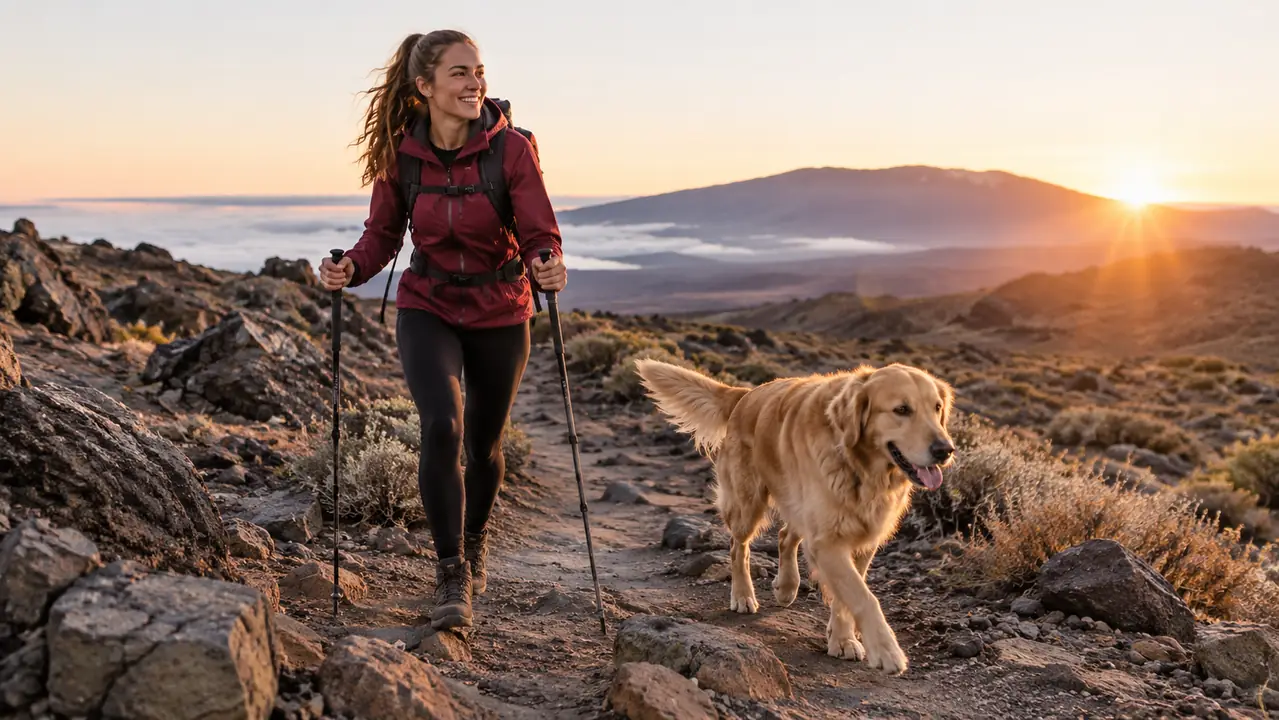
Short answer: Moss wears the Ruffwear Grip Trex shoes on three kinds of ground and goes barefoot on everything else. Rough lava rock. Hot exposed rock in July and August. Packed icy snow in winter. That is the whole list. On the soft dirt trails we walk most Saturdays near Bend, the shoes stay in the pack and his own pads do the work. I bought the first pair 18 months ago, and I have never strapped them onto him for a normal forest hike. Not once, and it was not an oversight.
That is not the answer most people expect from a piece about dog shoes. Plenty of the dogs I pass on the trail are wearing boots on packed dirt in mild weather, and plenty of them look unhappy about it. Plenty of others are picking their way across sharp rock in bare paws while their owner watches every step. Both of those are decisions about the ground, not about the dog. So here is how I actually make the call, in the driveway, with the pack open on the tailgate of the Subaru and Moss sitting in the back seat waiting for me to finish.
Side by Side on the Same Ground
| Ruffwear Grip Trex | Bare Paws | |
|---|---|---|
| Hot exposed rock | Ripstop upper and rubber sole sit between pad and rock | Direct contact, and the pad takes the heat |
| Sharp lava rock | A rubber sole under the whole pad | Pads meet the edges directly |
| Grip on packed snow and ice | Vibram rubber sole bites into the surface | Pads glaze over and slide |
| Cold, salt and wet | Ripstop upper blocks snow, salt and moisture | Nothing between paw and the cold |
| Feel of the ground | The sole mutes what the dog can feel | Full sensation underfoot |
| Setup time | Two boots, hook and loop straps, takes practice | Nothing to do |
| Heat on a long summer climb | Runs warm, which is why I pull them off | Cooler on the paw |
| Mud and grit | Grit works into the straps, hand wash only | Nothing to clean afterward |
| Weight and pack space | The pair weighs 4 ounces and takes up room | Nothing to carry |
| Best for | Rough, hot or icy ground | Soft dirt, forest floor, everyday trail |
Where the Ruffwear Grip Trex Shoes Win
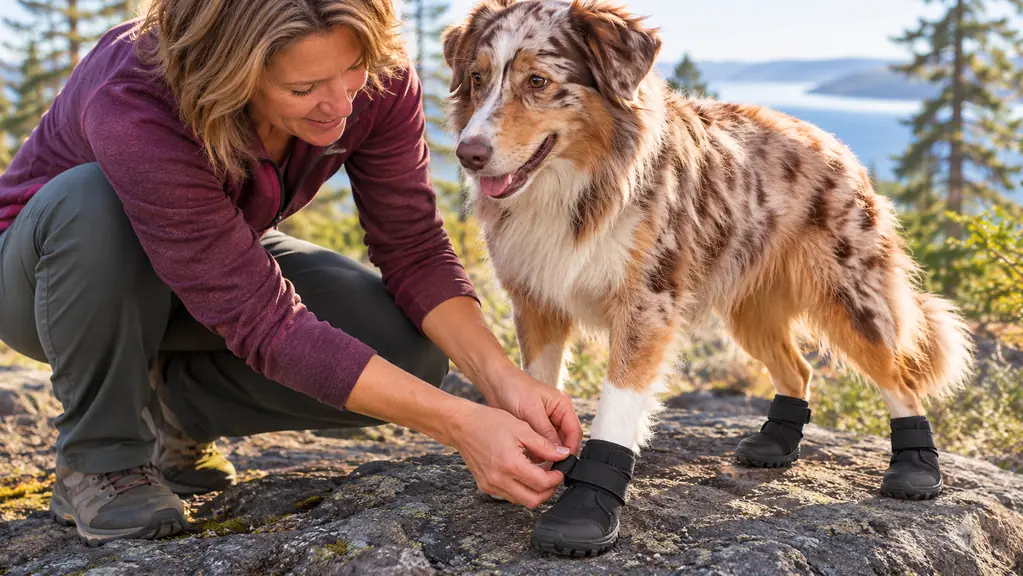
The first win is the obvious one. On hot exposed rock in summer, the shoes put a barrier between the pad and the surface. The listing describes a ripstop upper that blocks heat, snow, salt and moisture, and a Vibram rubber sole underneath. I am not going to tell you what that does to the temperature of a paw, because I have not measured it and I am not going to pretend I have. What I can tell you is that on the long rock stretches near the trailhead in August, Moss crosses in the boots instead of picking his way around the edges and hunting for shade.
The second win is sharp rock. Lava rock around here is not gravel. It has edges, and the edges are what make Moss shorten his stride and start choosing his line very carefully. That is his way of telling me he does not like what he is standing on. With the rubber sole under him he takes the same line he takes on dirt, at the same pace, which is the whole argument for the shoes as far as I am concerned. The ground stops being something he has to think about. There is a stretch on the trail I walk most Saturdays, half a mile past the second gate, where the path crosses an old flow and the rock breaks into flat plates with gaps between them. Moss used to pick through that section at maybe half our normal pace, head down, choosing every single step. With the boots on he takes it at the pace he takes the dirt.
The third is packed icy snow, which is where I expected nothing and got the most. The rubber sole bites. Bare pads on old snow glaze up and slide, and Moss is a 46 pound dog who does not need to be sliding sideways on a traverse above the trees. The thing to watch is the straps. They are hook and loop, they take practice to get snug, and a loose one can twist around the paw inside a quarter mile. When they are right, they stay on all day. When they are a little off, you will know fast.
The first sessions were their own thing. Moss high stepped around the back yard for about three short outings, lifting each paw higher than it needed to go, before he walked normally in them. Nothing about that worried me and nothing about it lasted. What I watch now is the straps at the halfway point of a hike. If a boot is going to work loose, it does it early, and once I stop and snug it, it stays put for the rest of the day.
Where Bare Paws Win
Most days. That is the honest version. On soft dirt and pine needle trails, which is most of what we walk, bare paws are simply better. A dog has a lot of information coming up through his pads and a rubber sole mutes it. Moss moves differently in the shoes on easy ground, a little flat footed and deliberate, like he is reading a page through a sheet of paper. Take them off and he is himself again, back on his toes, back to sniffing every third bush like it owes him something.
Setup time is the other one. Two boots, four straps and a dog who would rather be sniffing something about forty feet away. It takes me a couple of minutes per paw to get the straps right, and if I am honest about the first few weeks, it took longer than that. Bare paws require nothing. No pack space used, nothing to rinse, nothing drying on a towel by the back door. On a short evening walk it is not even a decision worth discussing.
Warmth is the last thing, and it matters in July. The boots run warm, which is half the reason I pull them off on a hot climb once the ground turns soft. Mud and grit are the other half. Grit works into the straps, the boots are hand wash only, and they need a rinse and a dry before the next hike or they go back on gritty. Bare paws handle a muddy spring trail with no follow up work at all, which after a wet week is most of what I care about. On a wet spring week I have left the boots home on purpose. Two of the trails we walk turn into a mud wallow after rain, and rinsing grit out of four straps and then waiting on them to dry is not how I want to spend a Saturday evening. Moss does not need them there anyway.
None of this is a knock on Moss. He is a 6 year old Australian shepherd mix who has hiked these trails since he came home from the rescue at 2, and he did not need boots for the first two and a half years of that. Worth saying plainly. The shoes solve a ground problem I started meeting more often as we went further out, not a dog problem. He is the same dog on the same trails at the same pace, with them or without them.
Lava rock around here is not gravel. It has edges, and edges are what make Moss shorten his stride.
How I Decide in the Driveway
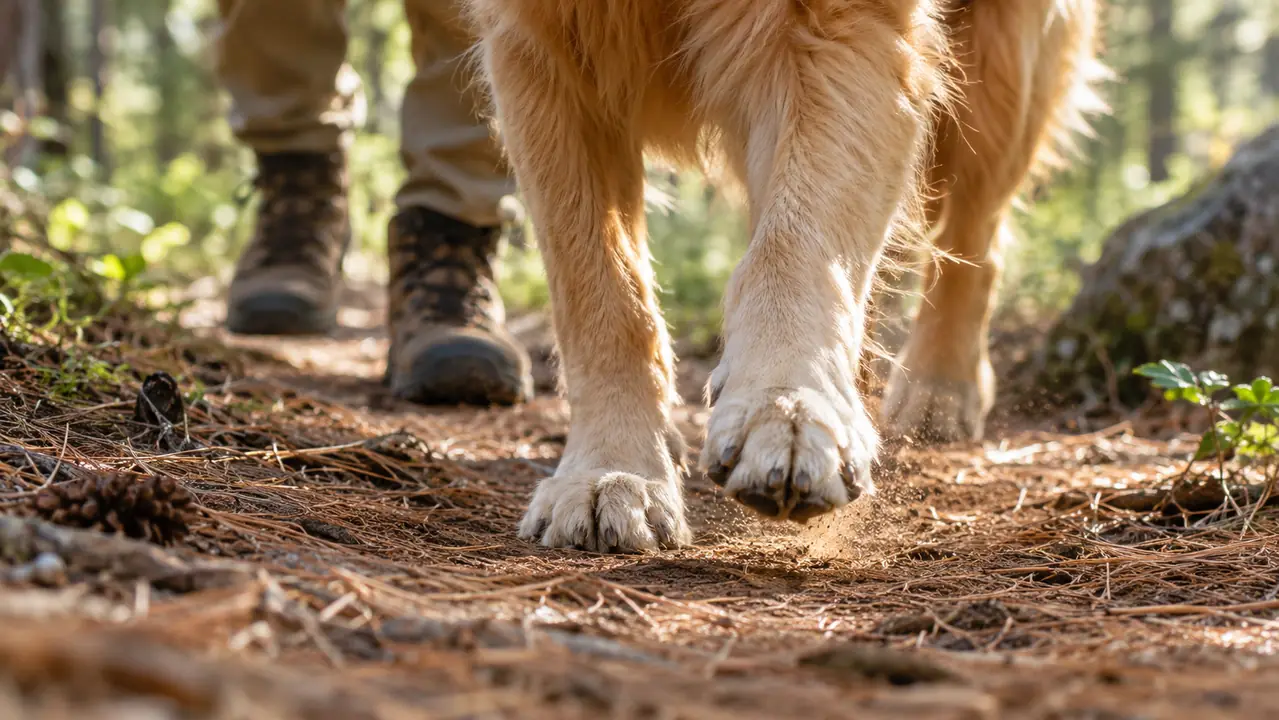
I look at the trail description first, not the weather. If the route has a lava rock section, the boots go in the pack whether it is 55 degrees or 80. If the route is forest floor and soft dirt the whole way, they stay on the shelf by the door. The one I get wrong most often is a mixed day, four miles of soft trail and then a rock crossing. On those days I carry them and strap them on at the crossing. The pair weighs 4 ounces according to the listing, so carrying them is not a burden I think about.
Weather is second. Packed snow and ice, they go on. Wet spring mud, they stay off, because the rinsing afterward is more work than the mud is worth. Hot exposed rock, they go on for the exposed stretch and come off once we are back in the trees. I also think about how far in we are going. A two mile out and back on soft ground, they stay home. A seven mile day where the rock sits in the middle of the route and the car is a long walk from anywhere, they come along even when the forecast is mild, because a decision made at the trailhead in bad light is a worse decision than the one I made in the driveway with coffee in my hand.
I also check what else Moss is wearing. On a longer day he has his day pack on, and the boots still go on his feet, but I check the straps once after the pack is settled and the load is balanced on both sides.
One more thing, and it is unglamorous. I check the boots themselves before they go in the pack. The straps pick up grit and burrs, and a strap with grit in it does not hold the way a clean one does. A rinse and an air dry by the door is the whole maintenance routine, and it is less work than the harness gets, since the harness cannot go in a machine either. None of the four boots has been lost, and eighteen months of Saturdays is a fair test.
What I Liked
- Rubber sole takes the edge off sharp lava rock
- Ripstop upper blocks snow, salt and moisture
- Stays on all day once the hook and loop straps are snug
- The pair weighs 4 ounces, small enough to carry for a mixed day
Where It Falls Short
- Sold as two boots, so four paws means two pairs
- Hand wash only, and grit works into the straps
- Runs warm on a long summer climb
- Straps take practice and a loose one can twist
The Fit Detail That Decides It
The size on the listing is 2.50 inches, and that is a paw width, not a shoe size in the way you think of one. I measured Moss's front paw across the widest part while he stood on a piece of paper on the kitchen floor, and that is how I landed on it. Get this wrong and nothing else about the boot matters. Too narrow and the paw is pinched. Too wide and the whole thing rotates no matter how tight you pull the strap. Front paws and back paws are not the same width either, and the front ones are the ones to measure. I measured Moss twice, once in the morning and once after a hike, and got the same number both times, which told me the number was worth trusting.
The other thing I would tell you is that a pair is a pair. The listing says sold in pairs, not a set of four, and it says it in capital letters because people miss it. I bought two pairs at once so all four paws are covered, and I would do it again. If you genuinely only need two paws covered, this is still a real product, but know what is arriving in the box before you start measuring on the kitchen floor.
If a lava rock crossing is on your route, this is the pair in my pack
Ruffwear Grip Trex Dog Shoes, sold as two boots, Vibram rubber sole, hook and loop straps, 4 ounces for the pair. Measure a front paw across the widest part before you order.
Amazon Check Today's Price on Amazon →Who Should Buy Which
Buy the Ruffwear Grip Trex shoes if the ground you hike is the reason you are shopping. Lava rock, hot exposed rock in summer, packed icy snow, sharp scree. Buy them if your dog will stand still for a strap and a minute of fiddling, and if you are willing to measure a paw before you order instead of guessing. Do not buy them expecting them to change a soft dirt hike, because they will not, and Moss is the proof of that on every Saturday we walk one.
One more thing on timing. If you are shopping in June for a hike in August, buy before the rock gets hot and take those three short backyard sessions seriously. Moss needed about three of them before he stopped high stepping, and I would rather that happen in the yard with the gate closed than on a rock crossing with the light going.
Stay with bare paws if your trails are forest floor and soft dirt, if your dog is out for an hour after work, or if rinsing grit out of two straps on a Sunday evening sounds like a chore you will skip. That is not a knock on the shoes. It is the reason mine sit on the shelf more weeks than they get used. The two are not competing for the same day. One is for the ground that earns it, one is for everything else, and most of the year is everything else.
For the rock day, not every day: the boots that live in my pack
Two boots, one specific job, and the only dog boots I have tried. Rinse them, dry them by the door, and they are ready for the next stretch of rough ground.
Amazon Check Today's Price on Amazon →