
Eighteen months ago I stood at a trailhead east of Bend with a dog who was picking his way across broken volcanic rock one paw at a time. Moss is a 6-year-old Australian shepherd mix, 46 pounds, about 21 inches at the shoulder. We have hiked together for four years now, mostly Saturday day hikes of four to nine miles on Cascade trails, and on soft dirt he is sure and easy to watch. On lava rock he is not. He hesitates, he chooses, he second-guesses, and a four mile day turns into a long one for both of us.
That is why I bought the Ruffwear Grip Trex Dog Shoes. Not because I wanted a dog in boots, and not because I think every trail needs them. I bought them for the specific ground that was slowing us down: rough lava rock, hot exposed rock in summer, and packed icy snow on winter outings. Everything else is bare paws, and that has not changed in eighteen months. What follows is what real use has looked like, including the parts that took practice and the parts that are still a compromise.
The Quick Verdict
They do the one job I bought them for: Moss crosses sharp rock without picking his way. The straps take practice and they run warm in summer.
Amazon Check Today's Price →For sharp rock under a dog who hesitates
Sold as a pair of two boots, so four paws means two pairs. I bought two pairs at once and the same four boots are still in service eighteen months later.
Amazon Check Today's Price on Amazon →How I've Used It
I bought the Ruffwear Grip Trex eighteen months ago, the newest piece of gear in a small kit that has otherwise stayed the same for years. Because the listing says it plainly, I will say it plainly too: the boot comes as a pair of two, not a set of four. Moss has four paws, so I ordered two pairs at once. Those four boots are the same four boots I am still using, rinsed after each trip and dried on the mat by the back door.
We started in the back yard on a weekday evening. Moss high stepped around like the ground had turned into something he did not trust, lifting each foot higher than it needed to go. That lasted about three short sessions. By the fourth he was walking normally, and the first real test was a rocky ridge trail east of town, four miles out and back, with the boots on the whole way.
The first mile of that ridge is the worst of it, a stretch of broken basalt where the trail is more suggestion than surface. Without boots he had been averaging maybe a mile and a half an hour through there, stopping to think at every gap. With them on he walked it at his normal pace, and we were back at the car before the light went flat. That was the day I stopped wondering whether I had wasted my money.
Since then the pattern has not changed. They go on for lava rock, for hot exposed rock in July and August, and for packed snow on snowshoe days. They stay off for soft dirt, for the shaded timber trails we walk most Saturdays, and for anything under about four miles. They ride in a stuff sack in the back of the Outback, and they are usually the last thing I check before we pull out of the driveway.
What You Get, and Where the Fit Actually Lives
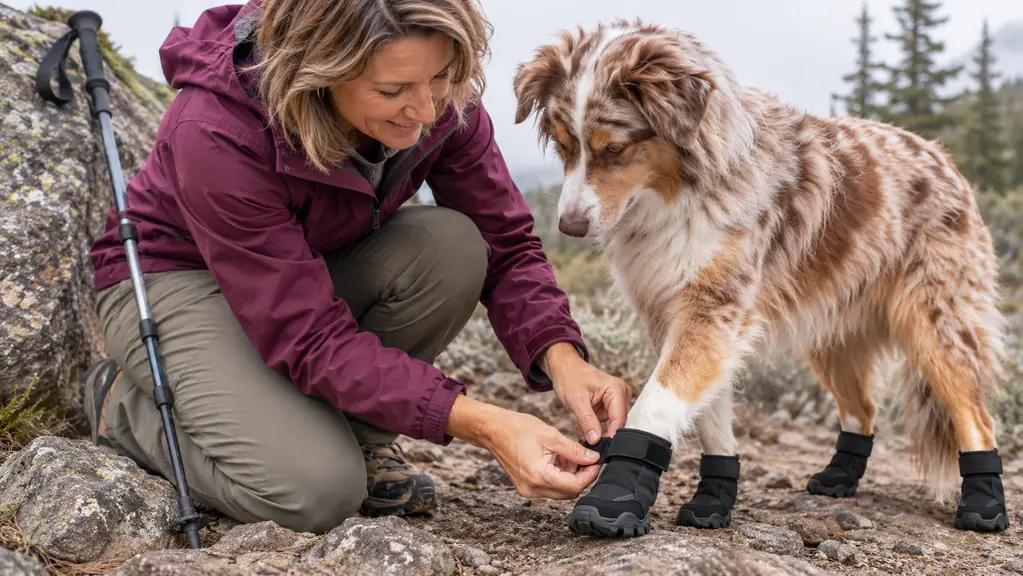
The boot is a ripstop upper over a rubber sole, with two hook and loop straps running across the top. Each boot weighs 4 ounces. The size I bought is listed as 2.50 in, and that number is the one that matters, not your dog's weight or breed. A 46 pound dog and a 60 pound dog can wear the same size boot, which is why Ruffwear sizes these in inches rather than by breed or by weight class. Measure the paw, order to the measurement, and be a little skeptical of anyone who tells you their dog simply wears a large.
I traced Moss's front paw on a piece of paper on the kitchen counter with his weight on it, then measured across the widest part of the pads. That came out right at the 2.50 in the listing names, which is how I ended up with the size I did. Doing it standing rather than lying down mattered, because a paw spreads out when a dog puts weight through it, and a measurement taken lying down will run small.
The listing says a proper fit means more comfort, control and confidence, and after eighteen months I would put it a blunter way: the fit is the whole product. A boot that is snug and set straight stays put. A boot that is even slightly loose will twist on the first steep pitch, and a twisted boot is worse than no boot, because your dog stops in the middle of the trail and stands there waiting for you to fix it while the rest of the group waits too.
Care is hand wash only, and I take that literally. Mine get rinsed in the sink, wiped down, and set by the door to dry overnight. The hook and loop straps collect grit, pine needles and dog hair, so I pick them clean with a fingernail every few trips. The upper is polyester and rubber and has held up fine across eighteen months of rock and snow. Nothing has torn, nothing has peeled, and no boot has come off a foot and stayed off.
On Lava Rock, Hot Ground and Packed Snow
Broken volcanic rock is where these earn their place in the pack. The rubber sole grips edges that a bare pad slides off, and the change in Moss shows up inside the first quarter mile. He stops picking, he stops hesitating, and he walks the way he walks on dirt. That is the entire reason I own them, and it is worth saying that the boots did not turn him into a different dog. They let him cross ground he already wanted to cross without slowing himself down.
Hot exposed rock in summer is the second job. On a July Saturday the rock surface holds heat long after the air has cooled, and a rubber sole between Moss and that surface is the point of putting them on at all. I fit them where we leave the timber and come out onto open rock, and I take them off when we drop back into shade. That is a judgment call every time, and if your dog runs hot or the day is genuinely hot, this is gear to think about more carefully rather than less.
The first summer I owned them I got that call wrong once. I left all four on through a shaded stretch that ran the better part of a mile, and Moss was walking flat footed and unhappy by the end of it. Now they come off the moment we are back under timber and go back on when we come out again, even if that means stopping twice in twenty minutes. He is much happier for it and the boots cool off in the meantime.
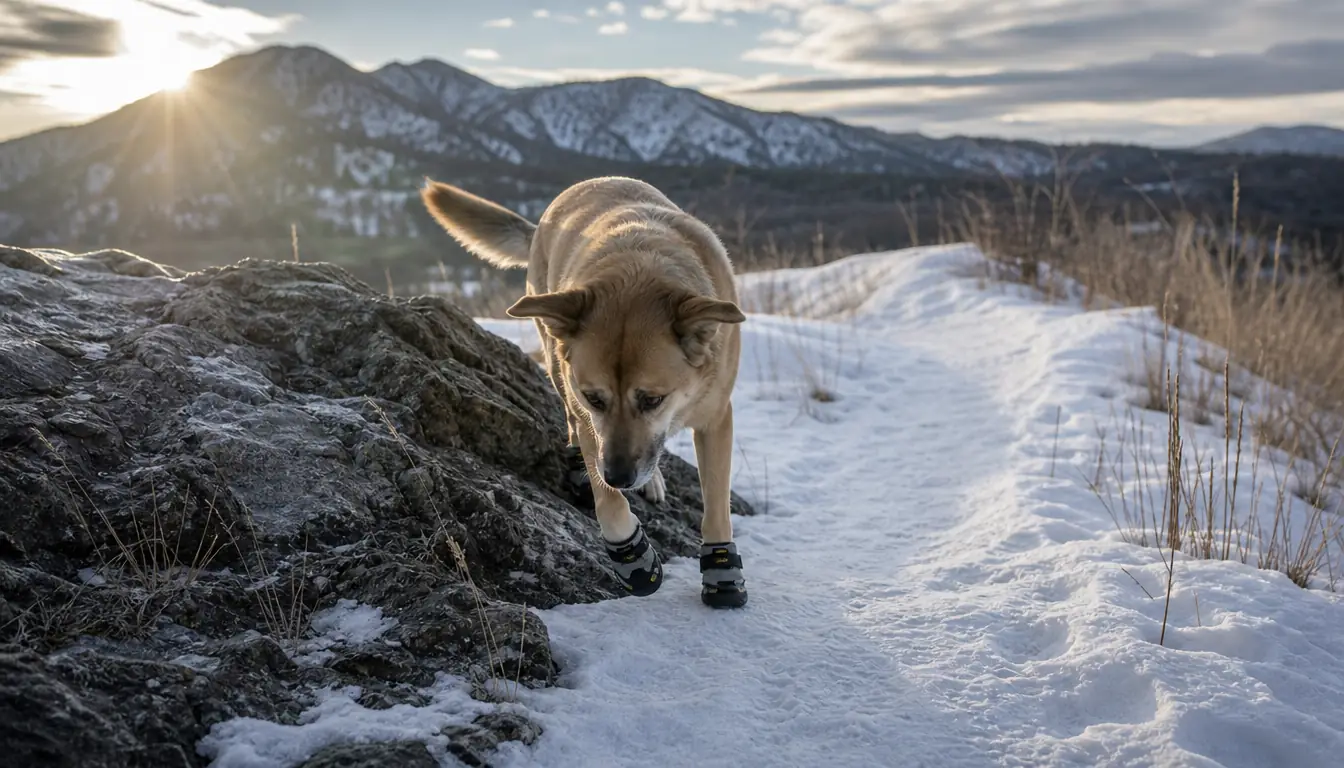
Packed icy snow is the third. Snow balling up between the pads is what ends a snowshoe day early for us, and with the boots on that stops being the thing that turns us around. Grip on packed snow is decent, clearly better than bare pads and nowhere near as good as what a person gets from a snowshoe. They are not a substitute for picking a sensible route on a cold morning. They just make the flat and rolling sections easier on him.
The Straps Take Practice
Two hook and loop straps per boot means eight straps to set on four paws, and the first several times I was slow at it. Getting a strap snug without cranking it too tight is a feel thing rather than a measurement, and it took me maybe a dozen outings before I could do all four in under a minute with cold hands. Moss stands still for it now, mostly because he has worked out that boots mean rock, and rock means the good trail.
The mistake I made early was over tightening. I wanted to be certain they would stay on, so I pulled the straps down hard, and Moss walked stiff legged for the first half mile before I loosened them off. Snug is not tight. The boot should sit flat against the paw with no gap at the front, and the strap should close with a little resistance rather than with effort. That is the whole calibration and it took me a season to trust it.
The routine that works for us is to set all four at the trailhead, then check each one at the first water stop. A strap that is snug at the car can loosen once the boot settles into the gait, and the first mile is where that shows up. I check again after any long descent, since that is where a boot works hardest against the foot. Two minutes of checking at a stop is the whole difference between boots that stay put all day and boots you are fussing with every mile.
What Eighteen Months Has Actually Done to Them
Eighteen months in, the uppers look better than I expected. The ripstop has not torn, no seam has opened, and the rubber sole still has its edge on all four boots. What shows wear is the hook and loop itself. The pile side of the straps has picked up grit and hair, and the grab gets a little less sharp with each season. That is the part I watch, and it is the part that will eventually retire these boots, not the sole.
The upkeep is small but it is not nothing. Mine get rinsed in the sink, wiped, picked clean at the straps, and stood by the door to dry. Hand wash only, no machine, and my guess is a machine cycle would shorten their life in a hurry. It is maybe five minutes of work after a hike, and it is the difference between four boots that are ready on Saturday morning and four boots you would rather not put in the car.
The rear boots wear differently than the front, which surprised me until I actually watched him walk. He pushes off with the back and lands with the front, and the wear reflects it, with the front pair showing more scuffing and the back pair taking more pressure at the toe. Swapping the pairs front to back every few trips has evened that out. Whether it matters over five years I cannot tell you, but it takes no time and costs me nothing.
Where They Fall Short
They are warm. On a hot day with a lot of sun, four boots on a dog who is already working hard is not kind, and I take them off at lunch and let Moss stand in shade for a while. I also would not call these an all day, every day boot. They are a tool for a specific surface, and treating them that way is what has kept them useful instead of annoying.
The pair of two detail is the other honest catch. You need two pairs to cover four paws, which is the part people miss when they order, and it is more of a commitment up front than the listing photo suggests. Hand wash only is a small irritation. And none of it matters on soft dirt, because on soft dirt these are unnecessary. If your trails are smooth and shaded, you can skip the whole category and put the effort into something you will use every week instead.
What I Liked
- Grip on broken volcanic rock, which is exactly what I bought them for
- Stays on through a full day once the straps are properly set
- Ripstop upper and rubber sole have held through eighteen months of rock and snow
- Rinses clean and dries by the door overnight
- Four boots on four paws once you order the second pair
Where It Falls Short
- Sold as a pair of two, so covering four paws means two pairs
- Eight hook and loop straps to set, and it takes practice to get them snug
- Hand wash only, no machine
- Warm on hot summer days, so they come off at lunch
- Pointless on soft dirt, which is most of our trails
Eighteen months and four boots, and the same four boots are still the ones I put on at the trailhead.
Who This Is For
This suits the weekend hiker whose dog slows down on sharp ground. If your regular trails run over lava rock, scree or hot exposed stone in summer, and you have watched your dog choose every single step, the Ruffwear Grip Trex is worth the practice it takes to get the straps right. It also suits winter walkers dealing with packed snow and ice on otherwise easy ground. The people who seem to get the most out of a pair are the ones who treat them as a tool for a surface rather than a permanent outfit.
Who Should Skip It
If your trails are soft dirt, forest floor or grass, skip them. If your dog genuinely will not tolerate anything on his feet after a fair trial in the yard, skip them and pick routes around the rough sections instead. If you are not going to check the straps at stops, skip them, because a loose boot is a fuss for the entire walk. And if you want one purchase that covers every hike in every season, this is not that. There is a fuller comparison of these against bare paws elsewhere on this site, and a separate piece on why a pair of boots earns a place in a hiking pack even if you only use them twice a year.
Two pairs, four paws, and a season of sharp rock
Order to the paw measurement, give your dog a few short sessions in the yard, and check the straps at every stop. That is the whole system, and it has held for eighteen months.
Amazon Check Today's Price on Amazon →