
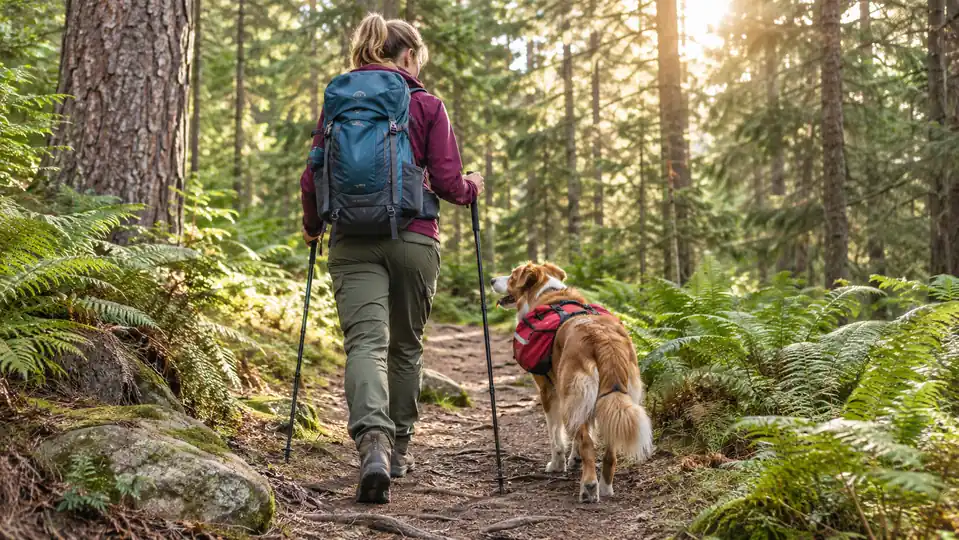
The first time I strapped a day pack onto Moss, I had already spent two years carrying his water in my own pack. I am Kari Brennan, 49, and I hike the Cascade trails near Bend, Oregon, most Saturdays from spring through fall. Moss is my 6 year old Australian shepherd mix, 46 pounds, about 21 inches at the shoulder, chest girth 28 inches. We do day hikes of 4 to 9 miles, plus a handful of one or two night trips each summer. I bought the Ruffwear Front Range Day Pack two years ago, after those first two years of carrying everything myself. That is the comparison here: the Ruffwear pack against my own back.
This is not a pack against another pack. It is a pack against a habit. Before the Ruffwear pack, Moss wore his harness, I wore my own pack, and every ounce of water for both of us rode on me. The question is simple: on which hikes does it make sense to let the dog carry his own water, and on which hikes does it just add fuss? My answer after two years is not all or nothing. It depends on distance, weather, and whether we are staying out overnight.
| Ruffwear Front Range Day Pack | Carrying It All Yourself | |
|---|---|---|
| Weight on the dog | Adds the 15.84 oz pack plus two 20 oz bottles of water | Nothing beyond the harness and leash |
| Carrying capacity | Carries the dog's water, poop bags and treats; I keep the load light | Your own pack carries as much as you choose |
| Fit and setup | Saddlebag design needs a minute to balance the two sides | Harness and leash only; nothing new to fit |
| Hot weather | Warm on a hot day, so I leave it home | No extra layer on the dog |
| Hikes over about 5 miles | Moss carries his own water; my pack gets lighter | You carry all the water; the load adds up by the end |
| Overnights | Moss carries his water and I carry the camp gear | Every ounce for the dog is in your pack |
| Leash attachment | Three leash attachment points; leash clips to the pack on pack days | One back ring on the harness |
| Load balance | Weight-forward saddlebag design with passive compression, once the two sides are even | No dog load to balance |
| Cleaning | Hand wash; grit collects in the zipper | Nothing extra to clean |
| Best for | Hikes over about 5 miles and one or two night trips | Short hikes, hot days and snowshoe outings |
What the Ruffwear Front Range Day Pack Actually Is
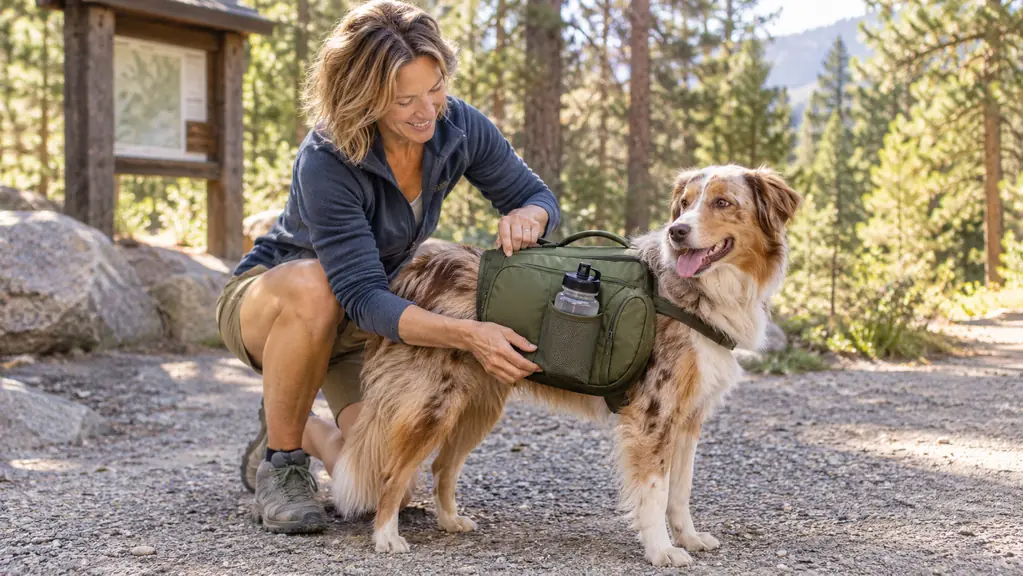
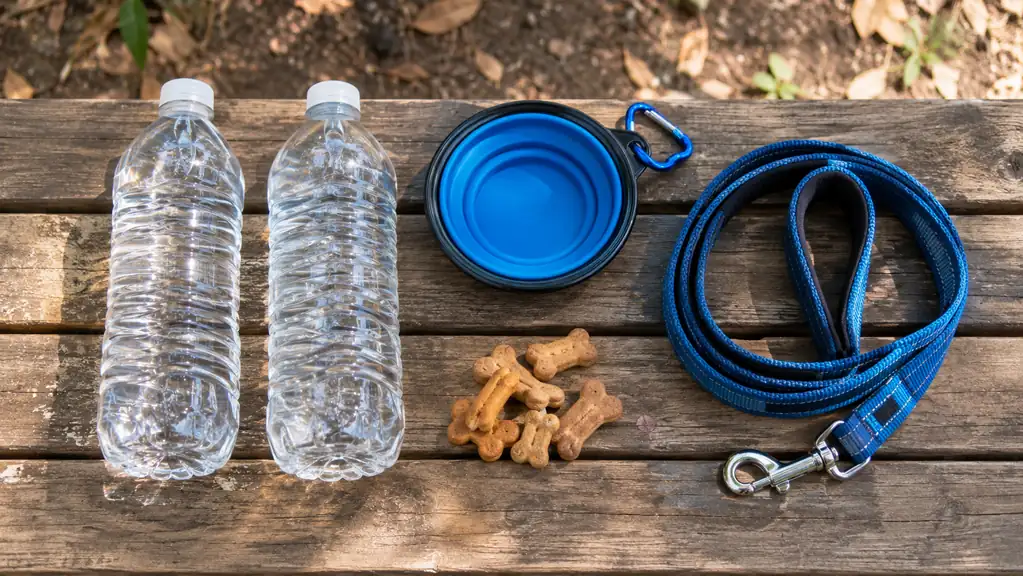
The Ruffwear Front Range Day Pack is a saddlebag style dog pack. The listing gives the Medium at 15.84 ounces, with a radial cut, a weight-forward saddlebag design with passive compression, a zipper closure, and three leash attachment points. The dimensions are 13.78 inches long by 23.62 inches wide by 3.94 inches high. That is the hardware. What matters on the trail is simpler: it lets Moss carry two 20 oz plastic water bottles from home, one on each side, plus poop bags and a few treats. That is the whole load. I do not pile more on him.
I bought it two years ago. Moss had no dog pack before that. On the first two short outings he walked a little stiffly, the way a dog does when something new is on his back. By the third outing he ignored it. I still do a fit check before we leave the car, and I still take a minute to get the two sides even. The pack is hand wash only. It is warm on a hot day, so I leave it home when the forecast is hot. I have never used it on a snowshoe day. Nothing has broken.
How I Compared the Two
I did not run a lab test. I just kept notes on my own routine. For Moss's first two years of hiking, I carried all his water and gear in my own pack. That was the only method I knew. I still use that method on short hikes, hot days, and every snowshoe outing. Since I bought the Ruffwear pack, I use it on hikes over about 5 miles and on our one or two night trips each summer. Same dog, same trails, same pace. The only change is who carries the water.
There is one other piece of gear that matters here. On pack days Moss wears the pack instead of his harness, and the leash clips to one of the pack's three leash attachment points. On every other hike he wears his Ruffwear Front Range Harness and the leash clips to the V-ring on the back. I use a hands free leash around my waist because I hike with trekking poles. I say that because the pack is not just a bag. On pack days it is also the leash point. If you already have a harness you trust, you are not replacing it. You are adding a second job for the dog.
The Fit Check I Do Before Every Pack Day
I do not just clip the pack on and go. I put the two bottles in first, one on each side, and set the pack on Moss. Then I check that the two sides feel even in my hands. If one side is heavier, the pack shifts, and I can see it when I look at him from behind. The whole check takes about a minute. The first time I did it, it took longer. That is normal. The pack has a radial cut and a weight-forward saddlebag design with passive compression, but none of that helps if I rush the load. A pack that is not even is just a bag sliding around.
The other check is the leash point. On pack days the leash clips to the pack, not the harness. I check that clip before we leave the car, every time. I also check that the pack sits where I put it after the first half mile. Moss does not tell me if something is off. He just walks. So I look. If the pack has shifted, I stop and reset it. That is not a defect. That is what a saddlebag pack is. It needs a minute of attention, and then it is fine for the rest of the day.
Where Ruffwear Front Range Day Pack Wins
The pack wins on the long days. On a hike over about 5 miles, two 20 oz bottles of water is real weight. Taking that off my back and putting it on Moss is the whole reason I bought the pack. He is 46 pounds and the load is light, so it does not look like much on him, but by mile seven I notice the difference in my own pack. On our overnights it is even clearer. He carries his own water, and I carry the camp gear. That split is the point.
It also wins on leash options. Three leash attachment points gives me a choice I do not have with a plain harness, and on pack days the leash clips to the pack. The radial cut and the weight-forward saddlebag design with passive compression keep the load close to his body when I have the two sides even. I am not going to tell you he loves the pack. He does not love it or hate it. He wears it and goes. That is what I want from gear. On a long day, the Ruffwear pack is the difference between me carrying 40 oz of water and Moss carrying it.
The last thing it wins on is the split itself. I am 49 and I hike with trekking poles, so my own pack already has water, layers, lunch, and a first aid kit. Adding the dog's water on top of that was fine for short hikes and less fine on a 9 mile day. The pack lets me move 40 oz off my back without making Moss carry anything close to a heavy load. That is a small thing on paper and a noticeable thing by the last mile. It is also why I reach for the pack on the days that matter and leave it home on the days that do not.
What Two Years Has Taught Me
Two years is enough to know the pack is not a gimmick and not a daily habit. It is a tool for specific days. I reach for it on the 7 to 9 mile hikes and on overnights. I leave it home on the 4 mile loops, on hot days, and on snowshoe days. That is not a knock. A lot of gear tries to be for everything and ends up good at nothing. The Ruffwear pack knows what it is. It carries a light load on a long day, and it gives me three leash attachment points when I want them.
I also know I wish I had bought it sooner. For two years I carried Moss's water in my own pack. That was fine. It was also heavier than it needed to be. I bought the pack because I wanted to split the load on longer days, and that is exactly what it does. Moss still hikes the same trails at the same pace. The pack did not make him a different dog. It just moved 40 oz of water off my back and onto his.
Two 20 oz bottles, one on each side, is the whole load. On a 9 mile day that is 40 oz of water off my back and on his.
Where Carrying It All Yourself Wins
Carrying it all yourself wins on simplicity. There is no fit check, no balancing two sides, no hand wash, and no extra layer on the dog. On a hot day that matters. The pack is warm on a hot day, so I skip it. On a short 4 mile hike, the water weight is not enough to change my day, and the pack is just one more thing to adjust at the trailhead. On snowshoe days I never use it. The harness and the waist leash are enough.
It also wins on the dog's comfort. Moss carries nothing but his harness and leash, and there is nothing to get used to. I am not anti pack. I am anti pack on every single hike. For two years I carried everything myself, and it worked. It was heavier, but it was simple. If you hike short loops, if your dog is small, or if you just do not want one more piece of gear to manage, carrying it yourself is a real answer, not a failure. The right side of this comparison is not a product. It is a choice, and it has a place.
The last point for carrying it yourself is the one I come back to on hot days. A dog pack adds a layer, and I do not want to add a layer when the sun is high and the trail is exposed. I leave the pack in the car on those days, put Moss in his harness, and carry the water myself. That is not a compromise. It is the right call for that day. The same goes for snowshoe outings. I have never used the pack in winter. The harness, the waist leash, and my own pack are all I need.
For the long days, let the dog carry his own water
The Ruffwear Front Range Day Pack is the one I reach for on hikes over about 5 miles and on overnights. The Medium is the size I use on Moss. It carries two 20 oz bottles, poop bags and treats, and the leash clips to the pack on pack days. It is not the right call on a hot short loop. On a long day, it is the difference between 40 oz on my back and 40 oz on his.
Amazon Check the Ruffwear Front Range Day Pack on Amazon →Who Should Buy Which
Buy the Ruffwear Front Range Day Pack if you do hikes over about 5 miles, if you take one or two night trips, and if you want your dog to carry his own water. It also makes sense if you already hike with a harness and a waist leash and you want a pack that gives you three leash attachment points on pack days. Carry it all yourself if your hikes are short, if the day is hot, if you are snowshoeing, or if you want zero extra gear to fit and clean. I do both. That is the honest answer. The pack is not a replacement for your own pack. It is a way to split the load on the days that call for it.
One more thing, because it is the question I get from friends at the trailhead. You do not need to use the pack every time for it to earn its place. I use it maybe half the Saturdays in a season, plus the overnights. The rest of the time it hangs by the door with the harness. That is fine. Gear does not have to be daily to be useful. It has to be right for the days you need it. For me, that is the long days, and that is enough.
If you are still carrying all the water, this is the pack I wish I had bought sooner
I spent two years carrying Moss's water in my own pack before I bought the Ruffwear Front Range Day Pack. It did not change his hike or mine. It just split the load on the days that needed it. If your Saturdays look like mine, a 7 to 9 mile trail with one dog and one pack, this is the piece I would add first.
Amazon See the Ruffwear Front Range Day Pack on Amazon →