
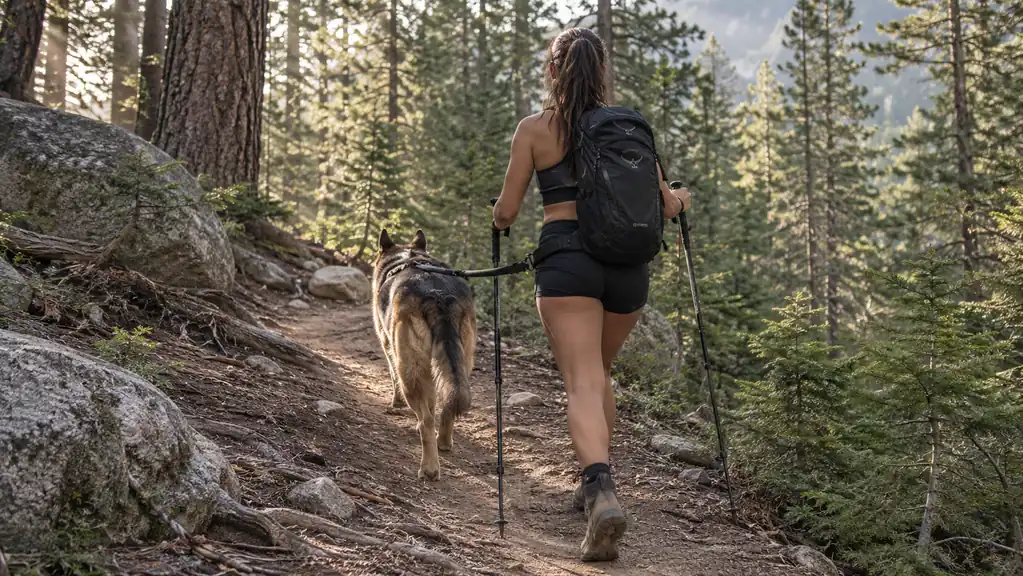
The first time I tried to hike with trekking poles and Moss on the same walk, I lasted about a quarter mile. One hand held the leash, the other tried to plant a pole, and every plant went in crooked because I was twisted sideways watching him. I tried looping the leash over my wrist, which made my shoulder sore by mile two. I tried clipping it to a belt loop, which worked right up until he spotted a chipmunk. What actually fixed it was a waist leash. The one I have used for the last three and a half years is the Tuff Mutt hands free leash.
I am not a guide, a vet or a trainer. I am a dental office manager in Bend, Oregon who hikes 4 to 9 miles on Cascade trails most Saturdays from spring through fall, plus snowshoe outings in winter and a couple of one or two night backpacking trips each summer. It is one dog and one pair of poles. Moss is a 6 year old Australian shepherd mix, 46 pounds, about 21 inches at the shoulder. What follows is the setup that works for us, in the order I would do it again.
Two free hands and one dog is the whole point
A 1 inch wide waistband that adjusts from 26 to 48 inches, a bungee that stretches 4 to 5 feet, and two handles for the tight spots. The whole leash weighs about 8.8 ounces.
Amazon Check Today's Price on Amazon →Step 1: Fit the Waistband at Home, Not at the Trailhead
Do this the night before, in your driveway, not in the gravel lot with your dog already pulling toward the trail. Put the leash on over the layers you will be wearing at the end of the hike rather than the ones you start in. Central Oregon mornings run cold and I am usually down to a t shirt by noon. A waistband fitted over a jacket will be loose by the time the jacket comes off, and a loose waist leash swings. I made that mistake in March, fitting the band over a rain shell in the driveway and then stopping twice on the trail by eleven to tighten it. Now I fit it over a t shirt and a light long sleeve, which is what I am actually wearing by the second mile.
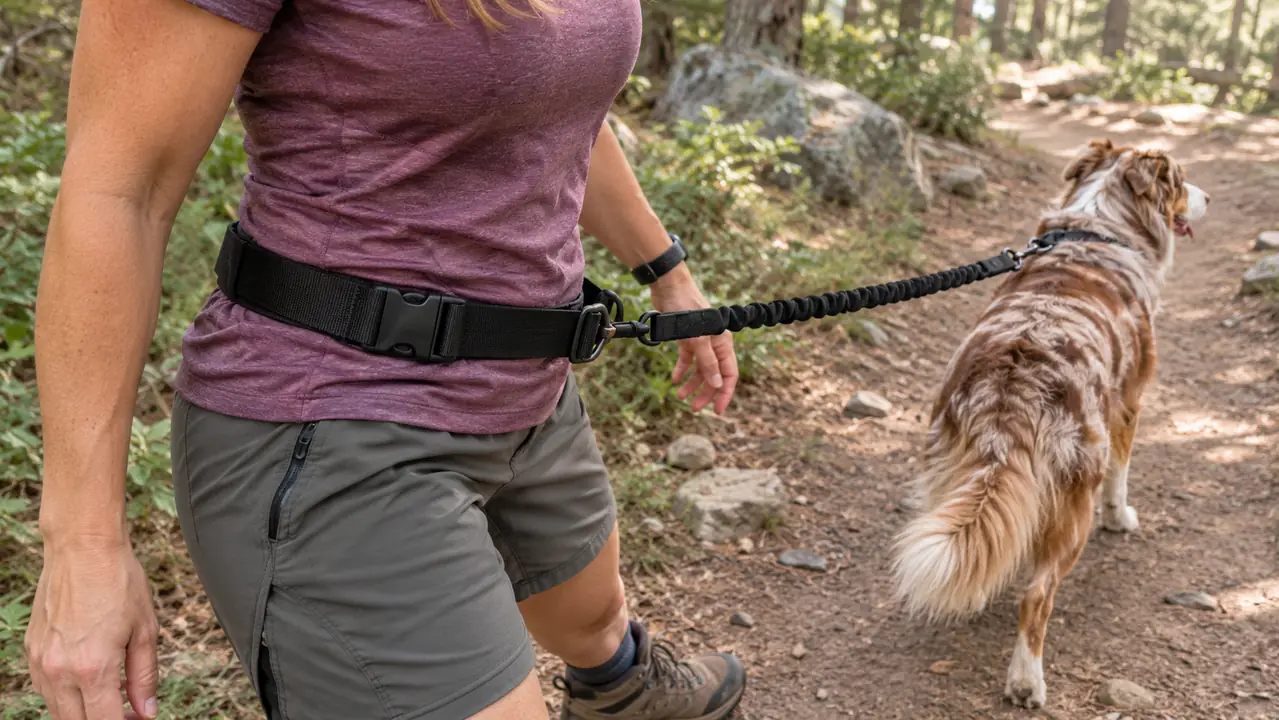
The waistband on the Tuff Mutt leash adjusts from 26 to 48 inches, and the closure is a snap clip, so there is nothing to thread or buckle with cold fingers. I wear it low, across my hips rather than up at my natural waist. A low fit keeps the line of the leash below my hands and clear of the pole grips, which sounds fussy until you have spent a mile with a leash sawing at your wrist. The band is 1 inch wide nylon and the whole leash weighs about 8.8 ounces, which is less than one of the water bottles I carry.
Then walk a block with some tension on it. Lean back a little, let the bungee load up, and watch whether the band rides up or twists to one side. If it does, tighten it a notch and try again. Moss waits in the back seat of the Outback while I do the driveway check, which is easier than doing it with him dancing at the end of the line. Mine has not needed adjusting mid hike in three and a half years, but that is because I spent ten minutes on it in a driveway first.
Step 2: Clip to the Harness, Not to the Collar
On a trail, the leash clips to the V ring on the back of Moss's Ruffwear Front Range harness. He still wears a flat collar with his ID tags, but the leash does not go on it, and that is a rule I settled on early. A harness spreads a pull across the chest and back rather than a single narrow band at the neck, and a day of hiking has a lot of small pulls in it, most of them caused by me rather than him.
Fitting that harness the first time took about ten minutes on the living room floor, and it has not needed changing since. The chest loop on the front I use only on the odd day Moss pulls toward wildlife. For hiking the leash stays on the back ring.
On days when Moss carries his own water, which means anything over about 5 miles and every overnight, he wears the Ruffwear day pack instead of the harness and the leash clips to the pack's own leash point. Same idea with a different anchor. The pack sits close to his body, the attachment is up near his shoulders, and the line runs clean from there down to my hip. The pack has three attachment points and the one on the back is the only one I use.
Check the hardware before you leave. Put a hand on the clip and tug it. The snap clip on this leash has held through three and a half years of Saturdays, but a clip is only as good as the ring you put it on. A thin, worn D ring on an old harness is not something I want to learn about halfway down a descent.
Step 3: Set Your Pole Rhythm Before You Add the Dog
Start with the poles and no dog, on flat ground. Hands on the grips, elbows bent, the tips landing behind you so you are pushing off rather than stabbing at the ground in front. Get that automatic first. If you are still thinking about your hands when the dog joins you, you will end up carrying the poles instead of using them. I spent a whole first season doing exactly that, with the poles strapped to my pack by mile three, because holding a leash and a grip in the same hand never worked.
The bungee is what makes a waist leash work with poles. On the Tuff Mutt leash it stretches 4 to 5 feet, so Moss can move a nose ahead on a climb and the leash takes up the difference instead of jerking my hips sideways mid stride. He walks on my left, the line runs from my left hip forward, and both hands stay on the grips. Where people get into trouble is letting the dog drift across the front of their body. Pick a side and keep the dog there.
It took Moss about three hikes to settle into walking a little ahead on the bungee without tugging. He is a herding mix and his instinct is to be right at my knee, which is exactly where a dog should not be when you are swinging two poles. The bungee gave him a range to drift forward into, and he found the end of it on his own. No training plan, just repetition on the same trail.
The first trail I tried any of this on was a 5 mile out and back I have walked dozens of times, and that mattered. I knew where it widened, where the roots were, and where I would want both hands free. Save the unfamiliar route for after the setup is automatic. On a trail you already know, you can pay attention to the leash and the poles instead of the map.
Three and a half years of Saturdays on the same waistband, and the clip still snaps shut with the same click.
Step 4: Use the Short Handle in the Tight Spots
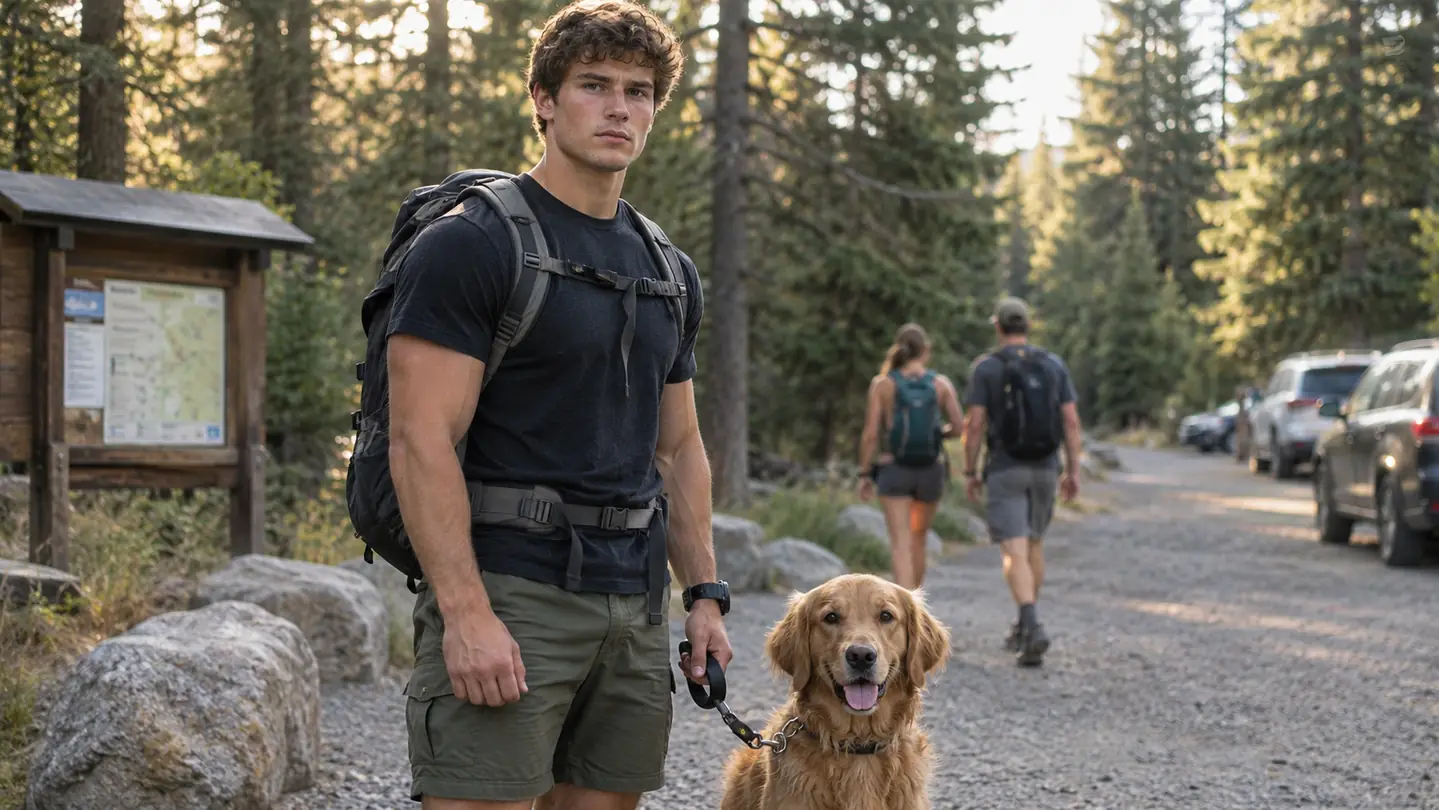
The leash has two handles, the hip handle and a shorter one near the clip. The short handle is what I hold at trailheads, in parking lots, and anywhere we are passing people. I take it in my free hand, bring Moss in close, and go back to the hip handle once we are clear. It takes two seconds and it is the difference between a pleasant pass and an apology.
The short handle earns its keep in the lot more than anywhere else. On a busy Saturday there are cars backing up, people pulling packs out of trunks and other dogs coming the other way. A dog on 4 to 5 feet of bungee in that mess is a liability. Hand on the short handle, dog at your knee, and walk out to the actual dirt before you let the line back out.
Steep downhills get the same treatment. When the trail drops away and Moss starts sliding forward on the bungee, I shorten up on the short handle so he walks beside me instead of pushing me down the hill. Not every descent. Just the loose ones where he is clearly gaining more ground than I want him to.
The honest limitation is the bounce. A shock absorbing bungee has some give in it, and a dog who hits the end of the leash at a run is going to send that give straight into your hips. Moss is 46 pounds and rarely pulls anymore, so for us it is a cushion. If your dog launches after ground squirrels with everything he has, this is not the leash I would hand you.
Step 5: Give It Three Hikes Before You Decide
Do not judge a waist leash on one outing, and do not debut it on your longest hike of the season. Pick a trail you know, somewhere around 4 miles, and go with no mileage goal. Every time the line goes slack, that is the moment you are rewarding, whether you say a word or not. If your dog has never worn a waist leash, the first outing is not the day to also try a new trail, new boots and a loaded pack.
By the third Saturday neither of us was thinking about it. Moss walked ahead on the bungee, I planted both poles, and the hike went back to being a hike instead of a coordination exercise. We are on the same trails at the same pace we were before. The Tuff Mutt leash did not turn him into a different dog. It changed what my hands were doing, and that was the whole problem.
Care is about as simple as it gets. I hand wash it now and then, mostly to get the trail dust and the harness smell out of the nylon, and I hang it on the hook by the back door with the harness. In three and a half years nothing has broken, no stitching has let go, and the clip still snaps shut with the same click.
The other thing I would tell you is to keep your old handheld leash in the car. Mine lives in the Outback's door pocket and comes out in town, at the vet, and anywhere I am not using poles. The waist leash is a trail tool for me, not something I want on a sidewalk at seven in the morning with a coffee in one hand. Having both means the waist leash never has to do a job it was not built for.
What Else Helps
The leash solves your hands. It does not solve water, feet, or the rest of the day. On anything over about 5 miles Moss carries his own water, two 20 ounce bottles from home, one in each side pocket of the Ruffwear day pack. A collapsible bowl hangs off the outside of the pack on a carabiner. I fill it about a third of the way at each stop, which is enough for him and does not waste water we carried up the hill. The bowl is 48 ounces and weighs 1.76 ounces, and it zips flat against the outside of the pack when we are moving.
Footwear is the other piece I would not skip, on the right days. Most trails near Bend are soft dirt and Moss hikes barefoot. On rough lava rock, on hot exposed rock in summer and on packed icy snow, he wears Ruffwear boots on all four paws. Getting the straps snug took him a few short sessions in the back yard before he walked normally in them, and a loose strap can twist. The waist leash is the part that lets the rest of it work, because it is the thing that gives me my hands back for the water, the map and the poles.
If your poles are still strapped to your pack, this is the fix
1 inch nylon waistband that adjusts from 26 to 48 inches, a bungee that stretches 4 to 5 feet, two handles, and a lifetime warranty. About 8.8 ounces on your hips.
Amazon Check Today's Price on Amazon →