Every hike I take with Moss has the same small problem buried in it, and it took me three years to fix it properly. He needs water. Not constantly, and not in any dramatic way, but he needs it offered to him in a container he can get his muzzle into, at a moment when he is actually willing to stop walking. On a four mile Cascade trail out of Bend, that is easy to forget, right up until the moment it is not.
For a while I did what I think most people do. I poured water into my cupped hand and let a 46 pound Australian shepherd mix lick it out of my fingers. That gets maybe three or four ounces into him before it runs down my wrist and into my sleeve. On days when I had both trekking poles out, I tried a plastic bag instead, which was worse. It folded shut, he pushed it around in the dirt, and I carried a wet bag for the rest of the loop. Three years ago I bought the Kurgo Zippy Bowl: 48 ounces, collapsible, zippered, 1.76 ounces, with a carabiner on the corner. It has been clipped to the outside of whatever Moss is wearing on every hike since, and it is the piece of his kit I would replace first if I lost it.
A Bowl That Rides on the Outside of the Pack and Weighs 1.76 Ounces
The Kurgo Zippy Bowl holds 48 ounces, zips down to 7 by 3.3 inches, and comes with a carabiner for a pack strap or a belt loop.
Amazon Check Today's Price on Amazon →How I Water Moss on the Trail, Step by Step
None of this is a system anyone taught me. It is what four years of Saturdays, one dog with a 28 inch chest, and a handful of one and two night backpacking trips have settled into. The steps are small. The details are the difference between a dog who drinks and a dog who walks away from a bowl.
One thing to say up front: I am a weekend hiker, not a guide, and I am not a vet or a trainer. I have no medical advice to give. What I have is a routine that works for one dog on Cascade trails of four to nine miles, and it is easy enough to copy if you want it.
Step 1: Clip It Where You Can Reach It Without Taking the Pack Off
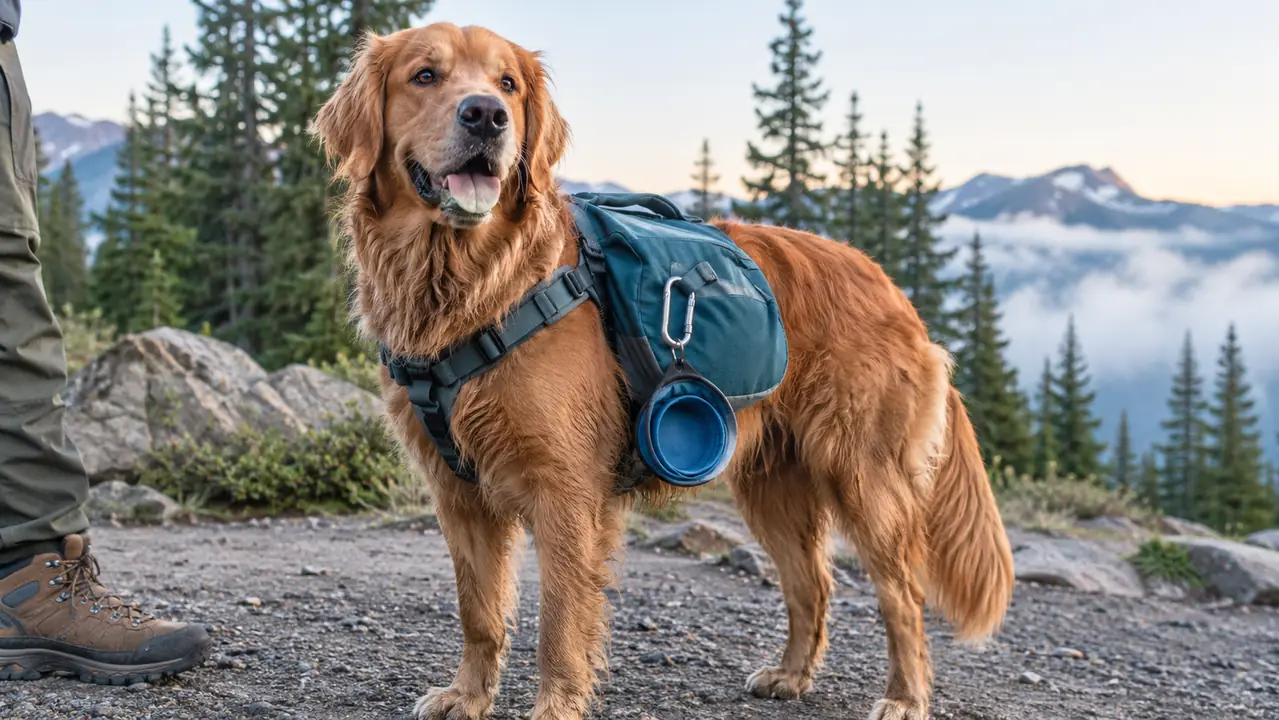
The carabiner goes on the outside of Moss's Ruffwear day pack when he is carrying his own water, which is every hike over about five miles and every overnight. On shorter hikes and snowshoe days he wears the Ruffwear harness instead, and the bowl clips to a loop on that. Same bowl, same corner, different anchor.
The goal is not a tidy setup. The goal is that I can reach it with one hand while my poles are strapped to my own pack and Moss is standing in front of me. If I have to unshoulder anything to get at the bowl, I skip the water stop. I know that about myself, so I set it up so that skipping is not an option.
Weather is part of this step too. The bowl rides on the outside of the pack, so it collects grit, rain, and the fine volcanic dust that gets into everything in central Oregon. I shake it out before I unzip it. That is the whole trail maintenance routine, and it takes about four seconds. In three years I have never had to do more than that out on the trail, which is more than I can say for most of what I carry.
Step 2: Unzip It All the Way Before You Pour
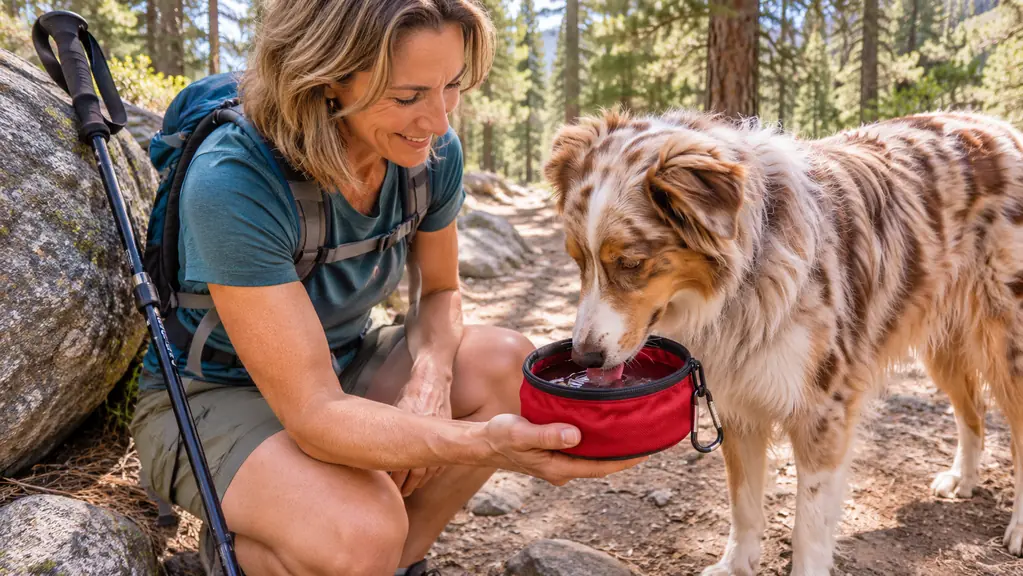
The Zippy Bowl is floppy until it is open. That is the honest tradeoff in a bowl made of fabric and a waterproof liner: folded flat, it has no shape to hold. Undo the zipper all the way around first, then set it down or hold it under the dog's chin, and it stands up on its own with a 6.5 inch opening.
If I pour first and unzip second, I get water into the zipper track and a bowl that will not sit open. I did that twice in the first month. Now the zipper is always step one, even when Moss is circling me because he can hear the bottle come out of the pack.
One afternoon on a dusty stretch of trail I unzipped it halfway, poured, and watched the whole thing fold in on itself and dump most of a third of a bowl onto my boot. Moss looked at the wet ground, then at me. I have not made that mistake since, and the fix costs nothing: zipper first, all the way around, and then water.
An open bowl on a slope will still tip if the ground is not flat. I look for a rock, a stump, or a flat patch on the edge of the trail. On a steep traverse I just hold it. It weighs less than two ounces, so holding it is not a chore.
Step 3: Fill It a Third, Not Full
Forty-eight ounces is a lot of water to hand a dog in the middle of a day hike, and water is the heaviest thing anybody carries. I fill the bowl about a third of the way at each stop. Moss drinks what he wants, usually less than I poured, and I tip whatever is left back into the bottle instead of dumping it on the trail.
That habit comes from the two years before Moss had a pack of his own, when I carried all of his water in my own pack. Every ounce I pour out is an ounce I carry up the next switchback. Even now, on an overnight when he is carrying two 20 ounce bottles in his side pockets, I still do not fill it to the top. A dog who is working hard drinks fast, and a full bowl usually ends up half poured out.
Two 20 ounce bottles is 40 ounces, a little less than the bowl holds at its stated capacity. Over a six mile day Moss will usually drink most of one bottle and leave the second for the truck and the ride home. Knowing that number is what stopped me from filling the bowl to the brim. The bowl is bigger than the job, and that is fine. It means I am never scraping the bottom of it on a hot climb.
If it is a short stop and he barely drinks, I put the bowl up. There is another stop in half an hour. Water offered often in small amounts beats one big bowl he ignores.
Step 4: Offer Water Before He Thinks to Ask
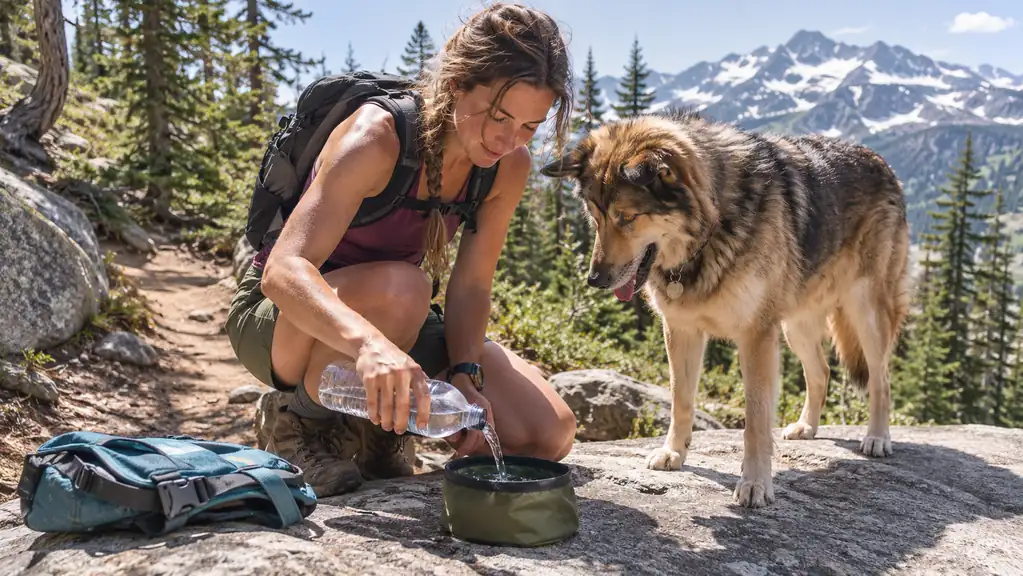
Moss does not tell me he is thirsty. He trots ahead on the bungee, nose down and tail up, and he would keep going back to the truck if I let him. So I stop on a schedule instead of on a signal: roughly every 30 to 40 minutes on a warm climb, and at the top of anything steep regardless of the clock.
I am not going to tell you what your dog needs medically, because I am not qualified to. What I will say is that offering water on a predictable interval is far easier than reacting to a dog who has already gone quiet on you. I hold the bowl under his chin, he drinks, I give him about ten seconds, and if he walks away I put it up. If he stands there and keeps drinking, he gets a little more.
The stop I never skip is the one at the top of a climb, before the trail flattens out. Moss will stand in the shade of a pine with his sides going, and he will drink four or five good laps there when he would not touch a bowl halfway up the same hill. I have learned to read that better than any clock on my wrist.
I also offer water at the trailhead before we start, not only on the trail. Moss drinks better at the start than he does at the end, and it costs me nothing but a minute in the parking lot while I get my boots sorted.
Step 5: Rinse It Out at Home, Not in the Creek
Grit works its way into the zipper. Not the liner, not the body of the bowl, the zipper track. Three years of Saturdays and that is the part that needs attention. I rinse it in the sink when we get home, open it all the way, and let it dry on a rack by the back door before I zip it back flat.
I do not wash it in a stream. Part of that is leave no trace and part of it is that a creek is not a sink. It also gives me a reason to look the bowl over once a week. That is how I noticed the carabiner gate getting stiff after a winter of snowshoe trips. The gate stopped snapping shut on its own and I had to push it closed with my thumb. A single drop of oil on the hinge fixed it in under a minute, and that is the only repair the bowl has needed in three years.
Nothing on the bowl has torn, split, or come apart in three years. The zipper is the only wear point I have found, and rinsing it keeps that from turning into a real problem.
Three years, most Saturdays, and the only part that has needed attention is the zipper track. Nothing has torn.
What Else Helps
The bowl solved the container problem, but it is not the whole routine. Water itself matters more. On hikes over five miles, Moss carries two 20 ounce bottles from home in his day pack, one in each side pocket, and I carry a third in my own pack. On shorter hikes I carry all of it and he wears just the harness.
Getting the dog used to the bowl before you need it helps as well. Moss drank out of the Kurgo bowl the first time I set it down, which I credit to him rather than to the bowl. A fussier dog might not. If yours is particular about containers, open the bowl at home with an inch of water in it and let the dog meet the shape on a normal day, not on a hot one.
I have never owned a dog water bottle with a built in trough. I looked at them when I was deciding and I did not want to carry something rigid that did one job. Hikers I pass on the trail use them and seem happy. My reason for the bowl is simple: it folds flat, it clips on with a carabiner, and at camp on an overnight I put Moss's kibble in it, so it does two jobs for 1.76 ounces.
On overnights that second job earns its keep. Moss eats his kibble out of the bowl at camp, and in the morning I rinse it in the sink at home before any water goes back in it. One less thing in my pack, and it is a lot easier to justify carrying a bowl when it feeds him as well as waters him.
Giving Moss a job changed our stops more than anything else on this list. Once he started carrying his own water, he stood still longer and pulled less toward the next switchback, and I had both hands free for the bowl. That is not a training insight. It is just what happened.
If your dog does wear a pack, balance the load. Two bottles, one on each side, or the pack slides to one shoulder. It took me a couple of short outings to get that right, and short outings are the place to figure it out.
And if you have been doing the cupped hand thing, I understand. It works well enough that you can talk yourself into it for years. It stopped working for me the first time I had both poles out and a dog who wanted to keep moving.
The Bowl That Lives on the Outside of Moss's Pack
48 ounces, 1.76 ounces of weight, a carabiner, and a lifetime warranty from an authorized seller. Three years of Saturdays and it has not let me down.
Amazon Check Today's Price on Amazon →