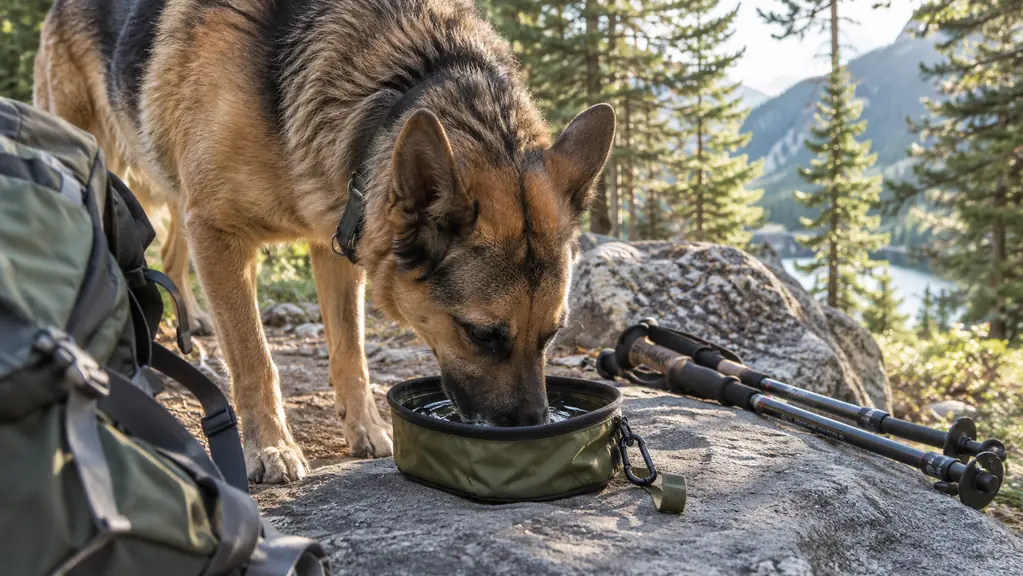
Short answer first, because that is what I want when I am reading one of these: the bowl. I have carried a Kurgo Zippy Bowl on every hike for three years, clipped by its carabiner to the outside of whichever pack is in use that day, and I have never come off a trail wishing I had brought a dog water bottle with a built-in trough instead.
But I have stood at a creek crossing with another hiker while her dog drank straight out of her bottle without her taking her pack off, and I understood the appeal in about four seconds. So this is not a piece about one thing being junk. It is about two tools that solve the same problem at different speeds, and the honest answer depends on how your dog drinks and how long you plan to be out.
| Kurgo Zippy Bowl | Dog water bottle with a trough | |
|---|---|---|
| Water it brings to a stop | Holds up to 48 fluid ounces when unzipped, and I decide how much to pour in | Whatever the bottle holds, delivered a troughful at a time |
| Weight and packed size | 1.76 ounces, zips down flat, hangs outside the pack on the included carabiner | A dedicated bottle that takes up a pack pocket |
| Serving it on the move | Stop, unclip, unzip, pour from my own bottle, zip it back up | Squeeze, the trough fills, the dog drinks, the pack stays on |
| Water your dog does not drink | Stays in the bowl, so I tip it out or offer it again | Goes back into the bottle, nothing wasted |
| Hands it takes | Two hands at first while you learn the zip, one after that | One hand, one squeeze |
| At camp | Doubles as his kibble bowl on overnights | Water only |
| Cleaning | Wide open, rinse and air dry, but grit does collect in the zipper | More parts and a trough to get into |
| Longevity | Three years of Saturdays, nothing torn, lifetime warranty from an authorized seller | Varies by model, and I cannot speak to any one of them from use |
| Best for | Day hikes, overnights, and dogs who gulp | Runners and dogs who sip as they go |
Where the Kurgo Zippy Bowl Wins
The first advantage is how much water actually arrives at the stop. The bowl holds up to 48 fluid ounces when it is unzipped open, and I fill it about a third of the way at each stop so I am not sloshing a small lake around in a fabric bowl. That is still more than Moss drinks at mile four of a Cascade trail, and it means I can offer him a real drink rather than a token one. The trough bottles I have looked at hold a good deal less. For a dog who sips, that is fine. For a dog who arrives at the top of a climb and empties whatever you set in front of him, it is a trip back to your own water bottle anyway.
Before the bowl, I tried two other things and both were worse. For the first year of hiking with Moss, I poured water into my cupped hand at every stop, which works for about four laps and then your hand is a puddle and the dog has had maybe an ounce. The other attempt was a plastic bag, held open at the top while I poured, and that ended with more water on my boots than in the dog. Neither was a disaster. Both were clumsy enough that I started skipping the stop, and a dog who is not offered water will not ask for it in any way I can read. That is the real argument for a bowl: it makes the offer easy enough that you actually make it, twice, on a warm Saturday.
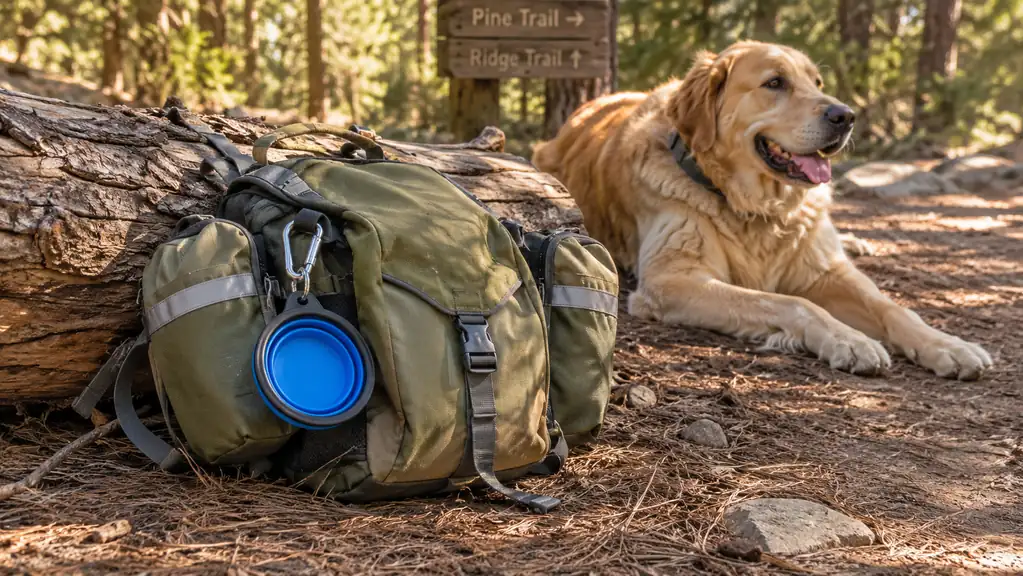
The second advantage is weight and where it lives. The bowl is 1.76 ounces, 7 by 7 by 4.5 inches open, and it zips down flat. It comes with a carabiner, so on a pack day it hangs off the outside of Moss's day pack, and on a shorter day it hangs off my own pack because he is in the harness and carrying nothing. I have never once had to reorganize a pocket for it. A bottle has to go somewhere inside a pack, and inside a pack is where things get buried under a rain shell and a bag of treats.
The third is the boring one that turns out to matter on overnights. On a one or two night trip, the same bowl is his kibble bowl at camp. One item does two jobs and I am not carrying a second dish. Add three years without a tear, a rinse at home after most hikes, and a lifetime warranty when it is bought from an authorized seller, and it has been the least dramatic piece of gear I own. Nothing has failed on it. The zipper has needed cleaning, which I will get to, but nothing has broken.
48 fluid ounces of water for 1.76 ounces of pack weight, on every hike for three years, and the fabric has never torn.
Where a Dog Water Bottle Wins
I have never owned one of these, so take this section as the view from across the trail rather than a field report. What I have watched, more than once, is a hiker squeeze a bottle, fill the little trough, let her dog drink, and tip the leftover water back inside without stopping walking. No pack off, no unclipping, no zipping. If you are moving steadily and your dog takes small drinks often, that is a smoother rhythm than mine. I stop, I unclip, I unzip, I pour, and by then the moment has passed for a dog who wanted two laps and nothing more.
The second genuine win is the unused water. Whatever Moss does not drink sits in the bowl, and my choices are to tip it onto the trail or hold it out again and hope. On a hot day with a long stretch between water sources, that adds up. A bottle takes it back. If I were hiking in dry country where every ounce is planned, that single difference would probably move me over.
There is also the matter of how much a dog actually drinks. Moss is 46 pounds and about 21 inches at the shoulder, and on a moderate 6 mile day he will take maybe a third of the bowl at each of two stops. It is not a lot. The bowl is overkill for the volume and exactly right for the delivery. On a longer day, or on a hot climb, the volume goes up and the arithmetic does not change much. Where the bottle pulls ahead is not volume, it is frequency. If your dog is the type to take a mouthful every twenty minutes, a trough you can squeeze without breaking stride simply fits that dog better than a bowl that requires a full stop. I have watched it happen and I have no counterargument.
The third is a smaller thing that only shows up after a few seasons: no zipper to clean grit out of. My bowl collects dust and fine trail grit along the zip, and it needs a proper rinse at home rather than a shake at the trailhead. A bottle has its own crevices, and I am not pretending it is self cleaning, but it does not have a zipper track. If the maintenance details are the part that makes you leave gear in the garage, that is worth weighing.
The bowl that has ridden outside my pack for three years
48 fluid ounces when open, 1.76 ounces empty, a carabiner included so it hangs on the outside instead of taking a pocket, and a lifetime warranty when bought from an authorized seller. Rated 4.6 from 884 reviews.
Amazon Check Today's Price on Amazon →How It Actually Works on a Saturday Hike
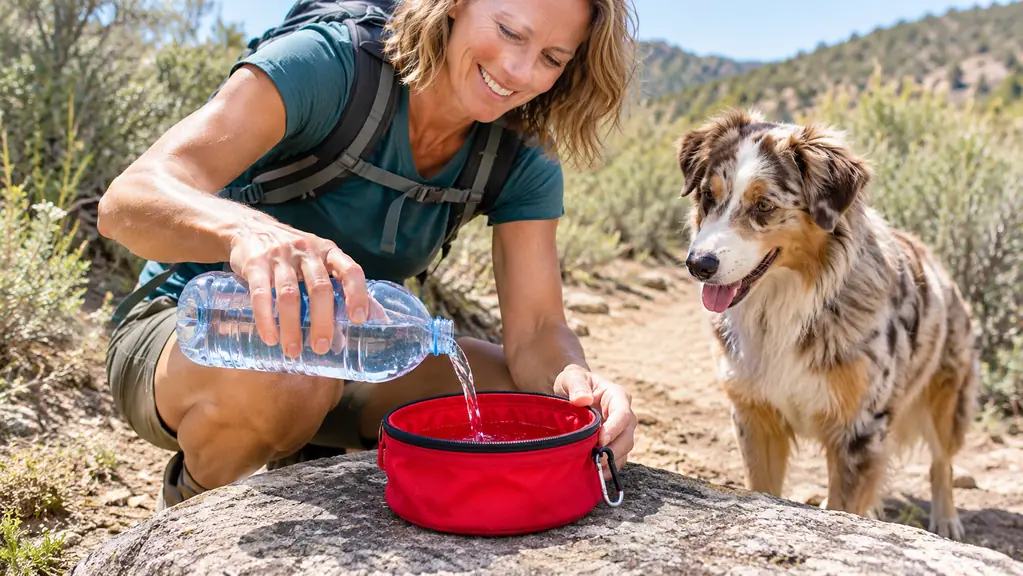
A normal Saturday for us is 4 to 9 miles on a Cascade trail outside Bend, Oregon, most weeks from spring through fall. The bowl comes off the carabiner at roughly the halfway point and at any creek we cross, which is usually two stops and sometimes three on a warm day. I pour from one of the bottles I am carrying, Moss drinks, I tip out what is left, I zip it shut and hang it back up. The whole thing takes under a minute, and most of that minute is Moss deciding whether he is finished.
The logistics are simple enough to describe exactly. On a pack day the bowl hangs off the outside of Moss's day pack by its carabiner, and the water lives in two 20 ounce plastic bottles from home, one in each side pocket of that pack. The bowl and the water are never in the same place, which sounds like a flaw and is not, because the bowl comes off the carabiner in about two seconds and a bottle comes out of a pocket in about three. On a shorter day Moss is in the harness and carrying nothing, so the bowl clips to my own pack and I carry the water. Either way the routine has the same shape, and after a few seasons I could do it without looking, which is roughly the test I apply to any piece of gear that comes on every hike.
The part nobody warns you about is that the bowl is floppy until it is unzipped open. It is a soft-sided bowl, not a rigid one, so it wants a flat spot and a hand while it fills. I set it against a rock or hold it low and pour into it. If you picture yourself holding it out at arm's length one-handed while your dog laps at it mid-stride, that is the bottle's job, not this bowl's. Once it is open and sitting, it holds its shape well enough to leave alone for a minute while I dig out a treat.
The Zipper Is the Part Nobody Mentions
Three years in, the honest weak spot is the zipper. Trail grit works into the track, and if I ignore it for a month the zip gets stiff and grainy. It has never jammed badly enough to matter on a hike, and it has never failed, but it does want a rinse and a dry at home now and then. That is the price of a bowl that folds flat. Anything with a zipper on a dusty trail is going to collect dust.
The fix is not elaborate. At home I open the bowl all the way, rinse it in the sink, work the zipper back and forth under running water, and leave it unzipped to dry overnight. If I do that after most hikes, the zip stays smooth. If I let three or four weekends go by with only a shake at the trailhead, I can feel the difference when I pull it open. I have never had to do more than that. No toothbrush, no lubricant, nothing fussy. But if the bowl lived in the bottom of a pack with dust and dog hair for a whole season without a rinse, I would expect the zip to be the first thing to complain, and I would not blame the bowl for it.
The other trade is that it is not insulated and it is not a bottle, so it does nothing for the water itself. I still carry water for both of us. The bowl is the delivery system, nothing more, and I would rather say that plainly than let anyone imagine it keeps water cold on a hot afternoon. It does not.
Who Should Buy Which
Buy the Kurgo bowl if your hikes are a few hours or longer, if your dog drinks in big gulps at a stop rather than sipping as he walks, if you do overnights and want one item for water and kibble, and if you like gear that lives on the outside of the pack and never needs to be thought about. It also suits anyone who would rather stop for a minute than fiddle with a bottle while walking. I wrote up the long version of how it has held up over three years if you want the deeper detail.
Buy a bottle with a trough if you run with your dog, hike fast and short, or have a dog who takes two laps and loses interest. It is also the better pick in dry country where you cannot afford to tip anything onto the ground. And if you are the kind of person who will not rinse a zipper, get the bottle. That is not a criticism, it is just how gear stays in the rotation.
And if your version of a dog hike is 40 minutes on a paved greenway, you probably need neither. Water at the car before and after is enough, and I say that as someone who owns a lot of small gear. The question is not which one is better in the abstract. It is how long you are out, how your dog drinks, and how much you care about keeping your hands free. For me, three years of Saturdays later, the answer is still the bowl clipped to the outside of the pack.
If your dog drinks in gulps instead of sips, start here
Collapses flat, zips shut, clips to a pack or a belt loop with the carabiner that comes with it. 48 fluid ounces when open, 1.76 ounces empty, and a lifetime warranty from an authorized seller.
Amazon See the Kurgo Zippy Bowl on Amazon →